
Heart disease has a real hereditary component, but genetics are not destiny. Family history matters most when a first-degree relative had a heart attack before age 55 (male) or 65 (female), a signal that warrants testing for apolipoprotein B, lipoprotein(a), and sometimes early coronary CT imaging. A landmark 2016 NEJM study found that a favorable lifestyle can lower relative cardiovascular risk by 46% even among those at high genetic risk. A person’s 30s and 40s represent a critical window for testing and prevention, since plaque can begin forming decades before symptoms appear.
Family history comes up in every intake conversation I have with a new member. It’s important, but it can also be a source of anxiety.
They might mention a father’s bypass surgery or a mother who died young of a heart attack, and I can see the worry cross their face.
So let’s answer the question directly: Is heart disease hereditary?
Yes, in a meaningful way, heart disease has some strong hereditary components. But here’s the headline I don’t want you to miss: Heredity is not the same thing as destiny.
With that understanding as a foundation, you’ll find there’s a lot you can do to protect your health.
Is Heart Disease Hereditary? Why ‘Yes’ Isn’t the Whole Story
Heart disease does carry a real hereditary component. If you have a first-degree male relative (father or brother) who had a heart attack before age 55, or a mother or sister before age 65, your own risk of premature cardiovascular disease grows roughly 1.5–2 times.
Nearly 75% of people with premature cardiovascular disease have a strong family history behind it. So yes, that’s a signal worth paying attention to.
But family history reflects two things at once. It captures inherited genetic susceptibility, and it also captures shared environment: the diet, activity patterns, and habits a household passes down as part of family habit and culture.
As you probably notice, one half of that equation is actually quite modifiable. And modification can make a big difference in outcome. But more on that later.
Why the Age of the Event Matters So Much
A father or brother’s heart attack before age 55, or a mother or sister’s before 65, points toward a real genetic driver. Think elevated cholesterol, high lipoprotein(a), or a strong polygenic risk score, all of which are testable and, critically, actionable in younger relatives.
A parent’s heart attack at 75 or later still raises your risk, but only modestly. That later event more likely reflects the ordinary cumulative wear of aging rather than a strong inherited signal.
What I Look for Beyond a Standard Cholesterol Panel
When someone with a strong family history sits down with me, I want a clearer picture of their current cardiovascular health than a routine lipid panel provides. To get it, I look at apolipoprotein B and lipoprotein(a), alongside blood pressure, because these markers catch risk that standard cholesterol numbers miss entirely.
If someone has both a strong family history and elevated levels on their labs, it often makes sense to move straight to advanced imaging. The goal is simple: Find out early whether plaque is already forming, so we have time to reduce your cumulative exposure to it over the decades ahead.
What a Scan Shows That Blood Work Can’t
I’ve seen plaque formation in patients as young as 30. Almost always, those are members with a strong family history and mildly elevated, or “borderline,” levels.
A coronary CT angiogram with Cleerly gives us a direct look at the arteries themselves rather than an indirect estimate from blood work. No lipid panel or even calcium score can tell you whether and how much soft plaque is actually sitting in your arteries, but Cleerly can. I’d rather have that information early so we can start playing offense.
For someone without much family history and reassuring blood tests, we can usually wait longer before imaging enters the conversation.
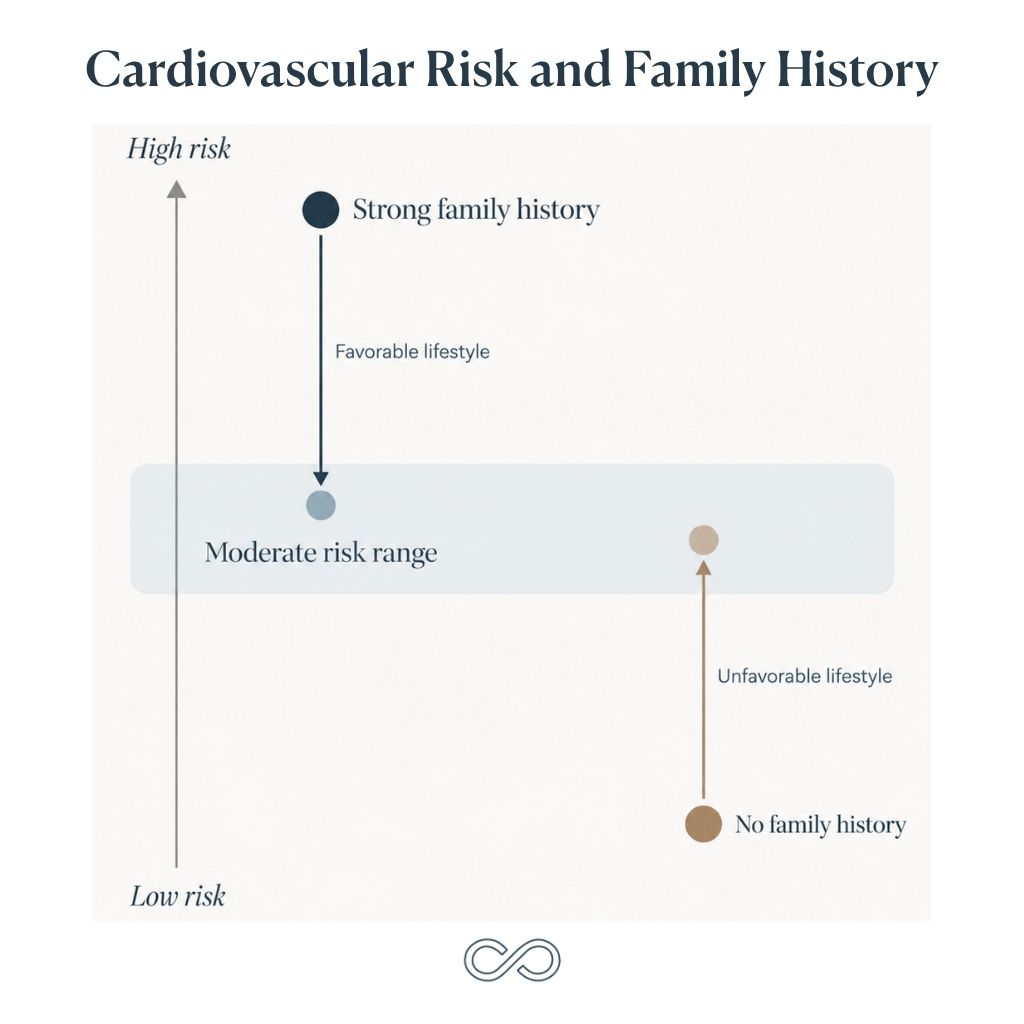
Heredity and Heart Disease: Two Common Myths
On the topic of whether heart disease is hereditary, I often hear two opposing beliefs, both of which can cause real harm.
The first is a belief that a parent’s heart attack makes your own outcome inevitable. The second is assuming that no family history means you’re essentially bulletproof. Neither is true, and there’s strong data to back me up on this.
A 2016 study in The New England Journal of Medicine followed roughly 55,000 people, comparing genetic risk against lifestyle. Among people at high genetic risk, a favorable lifestyle was tied to a 46% lower relative risk of coronary events. In practical terms, their 10-year event rate dropped from 10.7% down to 5.1%.
The reverse held true as well. Among people with low genetic risk but an unfavorable lifestyle, 10-year event rates climbed to 5.8%, nearly matching the rate seen in high-genetic-risk people who lived a healthy lifestyle.
The takeaway? Genes may load the gun, but lifestyle and early detection still have enormous influence over what happens next.
The mistakes I see most often in people in their 30s and 40s come from these same two myths: a posture of defeat when lifestyle changes could make a real difference, and false reassurance from a clean family tree leading to poor lifestyle and delayed treatment.
My Own Family History
None of this is theoretical to me; heart disease runs in my family. My dad has some significant but asymptomatic plaque, and I have other relatives who are heavy cholesterol producers by nature. I even lost a second cousin to a heart attack in his 30s.
That history matters to me, so I’ve tracked my own levels closely for years. At 30, they were fine but not optimal, maybe a B or B+ by my own grading. Because of my personal heredity factor, I made the decision to drive my numbers down into the bottom 10% of the population, using both lifestyle and medication to get there.
Years later, my levels are excellent and I’ve had no side effects. I plan to keep it that way, because time under a high burden is what does the damage, not any single number on a given day.
What to Do in Your 30s and 40s if Family History Is a Red Flag
Your 30s and 40s matter because plaque takes time to build and time to cause harm. Research suggests that once a calcium score climbs past 1, it typically takes another 10 to 15 years to reach a level of 100. That gap is your window for prevention.
So, start with the right blood tests, not just a standard lipid panel. Ask specifically for apolipoprotein B (ApoB) and lipoprotein(a), both of which are now class one recommendations for anyone with family history in the picture.
If a calcium score at age 30 comes back above 1, it’s worth being aggressive about optimizing your levels right away, even before symptoms or major plaque accumulation show up. The PREVENT risk calculator is a useful tool here, since it estimates your cardiac risk both 10 and 30 years into the future.
Keep in mind the calculator is built for people without known cardiovascular disease. If you’ve already had imaging that shows plaque, your actual risk runs higher than the calculator alone will show.
Finding a physician willing to dig into your personal story, not just population averages, matters here, too. Dr. Wenzel has written before about why self-advocacy is so important in healthcare and how finding your team can make all the difference in proactive care.
Is Heart Disease Hereditary? The Bottom Line
Heart disease remains the leading cause of death on this planet, so asking questions like is heart disease hereditary is a good investment in your health.
Yes, genetics matter. But testing, lifestyle, and sometimes targeted medication can meaningfully change your trajectory, regardless of what runs in your family.
So, now that you know the answer, you’re equipped to tackle your own risk based not on the population at large but on your individual factors. And if you’re still in your 30s and 40s, you have a lot of runway to do so.

Dr. William Pierce is a board-certified Family Medicine physician with experience in Emergency Medicine who joined Brentwood MD in 2025. He specializes in providing comprehensive, personalized care that combines preventive health strategies with acute medical expertise. Dr. Pierce is committed to building enduring patient relationships grounded in trust, clinical excellence, and collaborative health management.