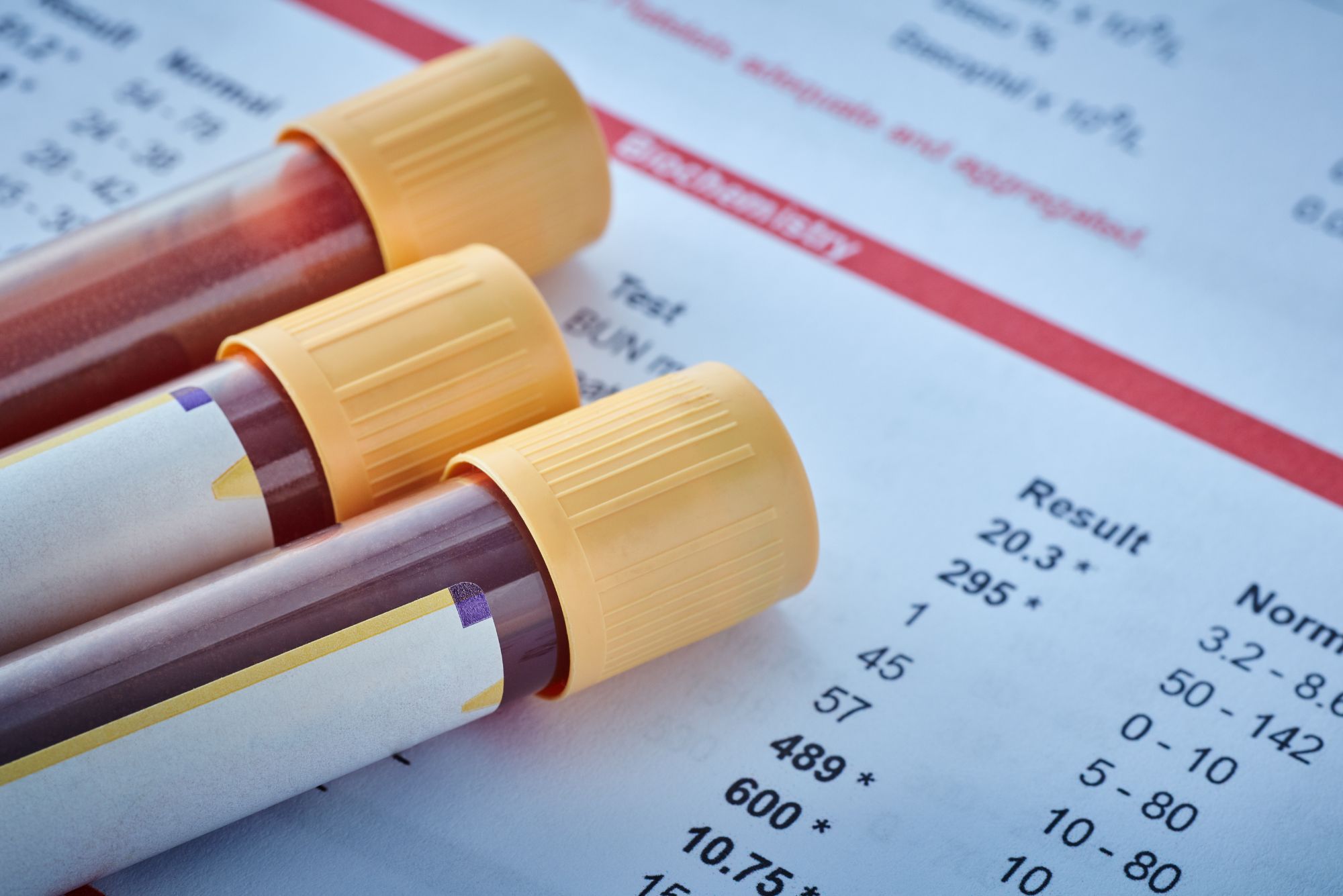
An ApoB blood test measures the number of “bad” cholesterol-carrying particles in your blood, a direct predictor of heart disease risk that standard cholesterol panels don’t capture. Unlike an LDL cholesterol test, which only reports the total mass of cholesterol circulating, an ApoB test reveals the number of individual particles present. More particles increase the risk that one or more will lodge in artery walls and drive plaque formation, making ApoB a stronger predictor of cardiovascular events.
Most people walk out of their annual physicals with a pretty simple cholesterol panel.
It’s the same one they’ve gotten for years: LDL, HDL, total cholesterol, triglycerides. If everything looks reasonable, the doctor gives them a thumbs up for the year.
But that standard panel can miss a major component of cardiovascular risk, which is why we’ve long relied on additional testing for members here at Brentwood MD. One of those is the ApoB blood test.
This screening tool gives us a more detailed look at true cardiovascular risk, which allows us to take a more proactive approach toward resisting heart disease and promoting longevity.
So, let’s talk more about the ApoB blood test: what it measures, why it matters more than LDL alone, and what to do with your results.

What Is an ApoB Blood Test, Exactly?
ApoB stands for apolipoprotein B, a protein that tags certain cholesterol-carrying particles in your blood, especially LDL.
A standard lipid panel only tells you the concentration, or total weight, of cholesterol being carried in your blood. It says nothing about how many individual particles are actually doing the carrying, and that distinction matters.
A popular metaphor for this is vehicles on a highway. Lots of cars may be able to transport lots of cargo, but they congest the roadway. Big trucks can bear the same load while creating much less traffic.
I sometimes like another simple image here. Picture a scale with two sides perfectly balanced. One side holds five large, weighted balls. The other holds 15 smaller balls. The total weight is identical on both sides.
The balls here represent particles in the bloodstream. The weight of the particles may be equal, but the 15 smaller balls are where we see problems. More particles means more chances for one to get lodged in an artery wall, which starts an inflammatory cascade that leads to plaque formation.
Two people can share the exact same LDL cholesterol number, yet the person with a higher ApoB number harbors greater cardiovascular risk because their blood has more cholesterol-carrying particles.
This is why the American Heart Association updated its dyslipidemia guidelines in 2026 to make the ApoB blood test a Class One recommendation.
ApoB vs. LDL: What the Evidence Actually Shows
The ApoB vs. LDL discussion isn’t simply about technicalities. It’s about which number actually predicts what happens in your arteries.
Research comparing the two markers consistently finds that ApoB outperforms LDL cholesterol as a predictor of cardiovascular events, sometimes by a wide margin.
LDL cholesterol has been the default lab test for decades. It’s inexpensive and universally available, which helped entrench it in standard bloodwork long before we understood its limitations.
But being the default test and being the best test aren’t necessarily the same thing. When the two numbers disagree, and they do more than you might think, ApoB tracks closer to your actual risk.
ApoB vs. Lp(a): Avoiding Confusion
If you’ve heard of the ApoB blood test before, you might also be aware of Lp(a), or lipoprotein(a), which has also been added to the American Heart Association’s recommendations. Since I sometimes get questions regarding ApoB vs. Lp(a) and which does what, I’ll take a moment here to discuss their differences.
ApoB reflects total particle burden across all atherogenic (plaque-forming) lipoproteins. Though it’s genetically influenced, it does respond to lifestyle changes and medication.
Lp(a) is a distinct, LDL-like particle that’s mostly genetically determined. It stays fairly stable across a lifetime and barely budges with diet or exercise.
About one in five people has an Lp(a) level high enough to carry a meaningfully elevated risk. While we can’t do much to lower your Lp(a) directly, knowing your number still matters, since it tells us how aggressively to manage everything else we can modify.
What ApoB vs. LDL Means in Practice
A specific pattern shows up often in practice. Someone’s LDL looks great on paper, sitting comfortably at goal, while their ApoB is quietly elevated into the 120s or 130s.
This is called “discordance,” and it shows up most often in people with insulin resistance, metabolic syndrome, type 2 diabetes, elevated triglycerides, or obesity. Instances of discordance mean a normal-looking LDL is masking real cardiovascular risk, which a simple ApoB blood test exposes.
A Real Example of Screening Beyond LDL
A few years ago, I spent a month training alongside Dr. Wenzel and reviewed my first Cleerly scan with a patient.
He had decent cholesterol numbers and a calcium score of zero from the year before, but he wanted to be proactive with his heart health. Imaging with Cleerly was the next step.
His results told a very different story than his standard labs. Despite the zero calcium score, he had a significant amount of soft plaque built up, the kind that’s more dangerous because it’s more likely to rupture. He and Dr. Wenzel shifted immediately to more aggressive lifestyle changes and pharmacotherapy, addressing the risk that standard care would have missed entirely.
Research data backs up how common this blind spot is. The Miami Heart Study looked at asymptomatic adults between 40 and 65, and nearly half had detectable plaque. Of that group, 16% had a calcium score of exactly zero, meaning a standard calcium scan would have entirely missed their disease.
While Cleerly is an excellent tool for assessing plaque burden in the moment, an ApoB blood test gives us insight into risk before plaque even develops. With that knowledge and a proactive approach, we can take steps to prevent plaque from even forming in the first place.
How to Lower ApoB: What Actually Moves the Number
So, if you discover your ApoB is elevated, what can you do about it? Learning how to lower ApoB starts with setting a realistic goal based on your age, your baseline levels, and your overall risk.
Lifestyle changes genuinely help, even if they can’t do everything. Weight loss in the range of 6–12% can meaningfully reduce ApoB, and a Mediterranean-style diet has solid evidence behind it, too.
Certain supplements offer modest support, including omega-3s and, for those interested in functional approaches, red yeast rice. Stacking all of these changes together typically produces up to a 20% reduction, since a large part of your ApoB level still comes down to genetics.
For some people, that 20% is enough to reach a healthy target. For those starting from a much higher baseline, it isn’t, and that’s where medication can be useful.
Statins remain the first-line option, and they’re some of the most studied medications in existence. Despite the social media chatter claiming a link to cognitive decline, I haven’t seen a single randomized controlled study supporting that claim. And research shows statins can lower ApoB by up to 45%.
Real side effects do exist with statins. That’s true. Muscle aches affect roughly 5–8% of patients, but we simply stop or switch medications if that occurs. Insulin resistance is the other main issue we watch for, though it shows up in only a small fraction of patients, and we make sure to monitor labs to catch it early.
Beyond statins, bempedoic acid works similarly in the liver and suits patients who can’t tolerate statins. Ezetimibe blocks cholesterol absorption in the gut for about a 20% reduction in ApoB, with excellent tolerability.
PCSK9 inhibitors are the newest and most powerful category of lipid-lowering drugs, delivered as an injection every two weeks or, very recently, as an oral option. In patients on these medications for a couple of years, we’re now sometimes seeing plaque burden drop on repeat Cleerly imaging, something older approaches rarely achieved.
Your First Steps for a Deeper Risk Assessment
If all this makes you want to know your own numbers, here’s where to start.
Talk with your doctor about family history first, since that shapes how aggressively you screen and treat. Ask for advanced lipid panel testing that includes ApoB and Lp(a), not just a standard cholesterol panel.
A risk calculator adds useful context from there. The traditional 10-year ASCVD calculator works well if you’re older, but the newer PREVENT 30-year risk calculator fits better if you’re younger and want to evaluate your long-term trajectory.
If your family history is concerning or your labs come back elevated, Cleerly imaging is worth a serious conversation. This scan gives you a direct look at your arteries rather than an estimate or guess.
The ApoB Blood Test: Bottom Line
Heart disease remains the leading cause of death on this planet, but it doesn’t have to catch you off guard. Your risk for heart disease is knowable, and it’s manageable once you know it.
An ApoB blood test gives you information a standard cholesterol panel simply can’t provide, and that information is what allows us to create a plan that’s built around your individual biology.
Knowing your numbers early gives you the chance to change your trajectory and, potentially, your entire future.


Dr. William Pierce is a board-certified Family Medicine physician with experience in Emergency Medicine who joined Brentwood MD in 2025. He specializes in providing comprehensive, personalized care that combines preventive health strategies with acute medical expertise. Dr. Pierce is committed to building enduring patient relationships grounded in trust, clinical excellence, and collaborative health management.