Download file | Play in new window | |
Last time Dr. Natalie Spradlin joined me on the podcast, we talked about the moments right after a patient finds out they might have cancer. We covered important topics like protecting your mental energy, getting a second opinion, and how to walk into that first oncology appointment as prepared as possible. If you missed it, When You Hear the Word “Cancer” is worth a read.
As an assistant professor of hematology and oncology at Vanderbilt-Ingram Cancer Center, a co-director of Vanderbilt’s Internal Medicine Miller Society, and a board-certified hematologist and oncologist with more than 14 years of clinical experience, Dr. Spradlin brings a unique perspective to topics that weigh on many people’s minds.
In our latest discussion, we take a look at evidence-backed ways to reduce cancer risk and detect cancer early, as well as the major types of cancer treatments and the role of clinical trials if you do receive a cancer diagnosis.
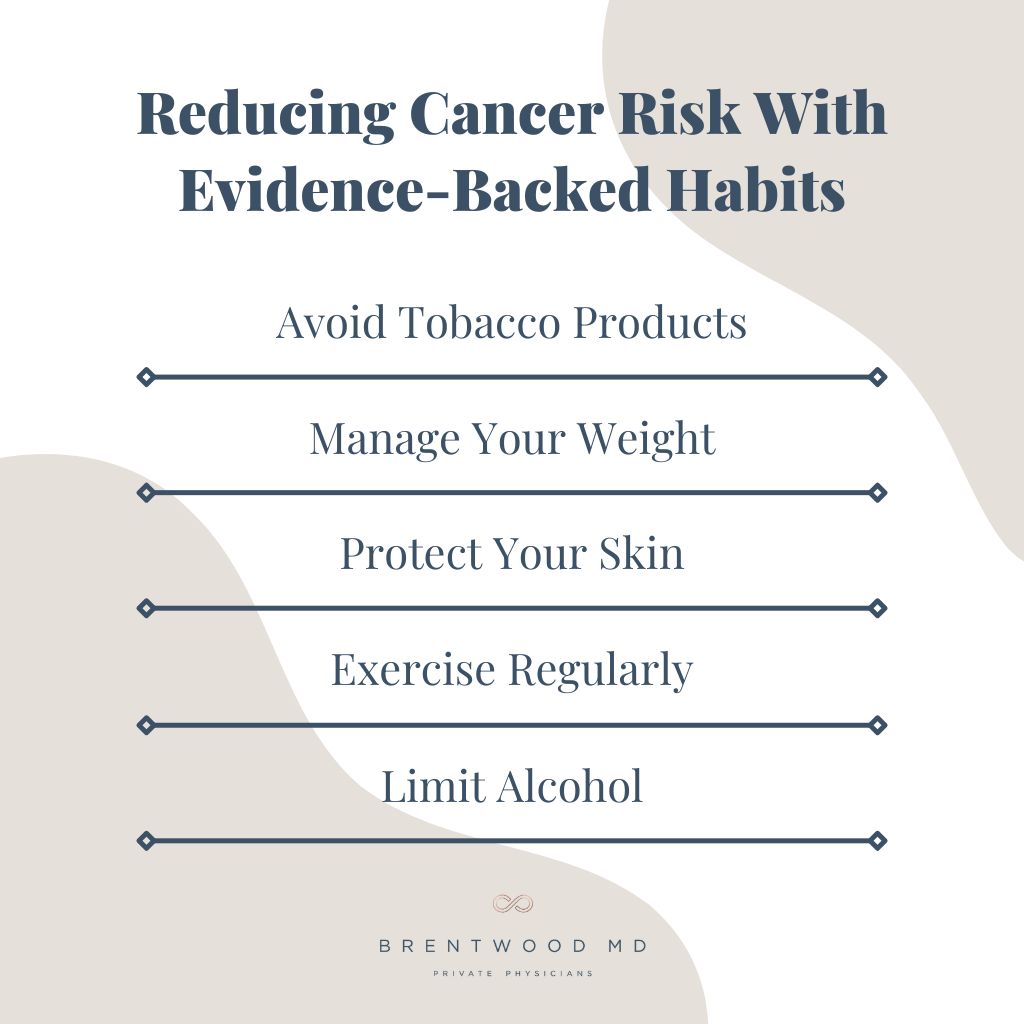
Reducing Cancer Risk With Evidence-Backed Habits
According to Dr. Spradlin, up to 50% of cancer diagnoses can be traced back to an environmental or lifestyle risk factor. That’s good news because it means a meaningful share of cancer risk is within our control.
Of course, there are no guarantees. We can certainly reduce our risk, but the other 50% of risk remains outside our control. That said, should cancer occur, the very same habits that reduce risk also help carry us through treatment and recovery. So rather than throw up our hands and say there’s nothing we can do, it’s worthwhile to follow these recommendations from Dr. Spradlin:
Avoid Tobacco Products
Regular smoking is linked to around 20% of all cancers in the U.S., and not just lung cancer; kidney, liver, bladder, pancreas, and more all increase in risk. Other tobacco products, like snuff, pouches, and chew, cause an array of cancers as well, including cancers of the mouth, tongue, and tonsils.
Tobacco is the single most well-established risk factor within your control. By staying away from it, or quitting if you’ve already started, you significantly reduce your risk of a wide variety of cancers.
Manage Your Weight
A healthy body mass index (BMI) is also linked to a decreased cancer risk. “It doesn’t mean you’ve got to be skinny,” Dr. Spradlin says. “But a BMI under 30 has been shown to reduce certain cancer risks.”
She also emphasizes that, while useful, BMI is an imperfect tool and needs to be read in context. Someone who lifts heavy weights, for example, may never register under 30 despite being lean and healthy.
Protect Your Skin
Damage from ultraviolet radiation, which comes from the sun or tanning beds, increases your risk of developing skin cancers, including melanoma, the most dangerous form. Sun protection, such as wearing a hat, donning protective clothing, or applying sunscreen appropriately, reduces this risk.
Exercise Regularly
Regular exercise has been shown to help with a long list of chronic health conditions. Relevant to our discussion, a major study found that it also reduced cancer risk by 26%!
Limit Alcohol
Alcohol is a carcinogen that, depending on the amount consumed, has associations with liver, breast, colorectal, and some head and neck cancers. Cutting back is one of the more straightforward levers you can pull to reduce your cancer risk.
Cancer Screening Options for Early Detection
Beyond prevention, the next line of defense is catching cancer as early as possible. “Human nature is to want to stick our head in the sand and not know,” Dr. Spradlin says. “But if you can identify cancer sooner or earlier, it’s more curable.”
Standard guideline-based screenings, like mammograms and colonoscopies, remain the backbone of early cancer detection. Keeping up with these screenings matters more than almost anything else you can do.
Beyond the standard screenings, there’s growing interest, and growing noise, around newer detection tools. Here’s how Dr. Spradlin thinks about each one.
Family History and Genetic Testing
I wanted to get Dr. Spradlin’s take on the modern phenomenon of genetic testing and whether it offers benefits for the average person’s cancer screening.
While Dr. Spradlin doesn’t recommend broad genetic testing for those at average risk, she does believe it’s useful in some situations. “Certainly there’s a role for it if there’s a family history of a particular type of cancer,” she says.
Inherited syndromes, like Lynch syndrome, predispose people within a family tree to clusters of certain cancers. Recognizing the pattern can prompt targeted testing through a cancer genetics team to determine whether a person is at risk.
Additionally, a family history of cancer may shift the timing of recommended screenings. “If there’s a primary first-degree relative diagnosed with breast cancer, the mammogram for the children needs to come 10 years before the age of the youngest person diagnosed,” Dr. Spradlin explains. In other words, if a mother was diagnosed at age 46, her daughter should begin breast cancer screening no later than 36, even though routine mammograms normally begin at 40.
The same logic applies to colorectal cancer, where young diagnoses are on the rise.
Another form of genetic testing offers help not in prevention but in treatment of cancer. This testing looks at the genetics of the tumor itself rather than the genes you were born with.
Tumor genetics reveals the specific mutations present within the tumor and helps inform the most effective treatment. Even if two people have the same cancer type, the genetics of their tumors may mean they end up on very different treatment plans. This is a big reason Dr. Spradlin cautions patients about comparing their cancer journey to someone else’s. The stories may look similar on the surface, but they likely have important differences hidden below.
Whole-Body MRI Cancer Screening
Whole-body MRI cancer screening has become a popular option marketed directly to consumers, and it’s a topic my members ask about frequently. Dr. Spradlin’s take is direct: She doesn’t order these scans for people without symptoms or an established risk factor.
“It’s never been proven,” she says. “The cancer detection rate is 1.6%, and it’s never been shown to have a mortality benefit.”
The scans carry a false positive rate of around 16%, meaning they often find ambiguous “incidentalomas” that lead to more testing, cost, and anxiety, but which turn out to be completely benign.
Personally, I’ve yet to see one of these scans come back completely clean, since many of us have something odd going on in our bodies at any given time: a cyst, a nodule, etc. But that doesn’t mean we have cancer, or that we even need further testing. In fact, invasive testing may pose more danger than leaving it be.
A “clean” result doesn’t guarantee you’re in the clear, either. The scan can miss cancers in areas it doesn’t visualize well, such as the lungs and colon, providing a false sense of security, which could lead people to ignore emerging symptoms or forgo important standard screenings.
The exception here is for those already considered high-risk for a specific cancer. In these cases, Dr. Spradlin says they may have good reason to discuss adding this kind of imaging on top of standard screenings.
Low-Dose Chest CT for Smokers
While MRIs don’t do the best job at detecting lung cancer, we do have a well-established screening that does.
For people ages 50 to 80 who’ve smoked 20 or more pack-years, an annual low-dose chest CT is a proven screening tool for lung cancer. This test is recommended once per year and is covered by insurance.
Colorectal Screening Options
Colonoscopy remains the gold standard for colorectal cancer screening, since it can both detect and remove precancerous polyps. But I’m aware that not everyone is willing to get one. Since the best test is the one that gets done, I talked with Dr. Spradlin about alternative types of colon cancer screening and their effectiveness.
Of the two alternatives, she preferred stool DNA tests, like Cologuard, as the more effective option. These tests, which you take every three years, involve sending a stool sample to a lab where they look for abnormal DNA and/or traces of blood that could indicate cancer.
The other option is a yearly fecal immunochemical test (FIT), which checks for hidden blood in the stool. While still a reasonable option, FIT tests are somewhat less sensitive and don’t check for the presence of abnormal DNA.
So, while a colonoscopy is the most effective screening and even involves an element of prevention, these alternative methods provide solid options for those who can’t or won’t get one. “If it brings somebody in to get screened that otherwise would never have been screened, these are very reasonable,” Dr. Spradlin says.
The Future Role of AI in Screening
I asked Dr. Spradlin how AI technology might play a role in future cancer screening. Though we don’t have long-term outcomes data yet, she sees a complementary role for AI ahead, not a replacement one.
For example, AI is starting to show promise in mammography, which will potentially help radiologists review a higher volume of scans and flag anomalies for closer human review. This reduces bottlenecks and speeds the process of testing and diagnosis, but Dr. Spradlin maintains that “a computer is never going to be able to replace a human’s ability to synthesize the information.”
Understanding the Types of Cancer Treatment
Dr. Spradlin and I also spoke about what happens if you do discover cancer, either through one of these screening methods or due to symptoms or other testing.
Cancer treatment generally falls into three categories: surgery, radiation, and what Dr. Spradlin calls systemic therapy, which includes traditional chemotherapy along with several newer approaches. The combination of treatments a person receives depends heavily on cancer type and staging (whether the cancer is localized, has spread regionally, or has spread more widely).
Before Cancer Spreads: Localized Treatments
Surgery and radiation both treat cancer locally. Surgery removes it from the body directly, while radiation targets and destroys it with focused energy. For a cancer still confined to one area, one or both may be enough on their own.
After Cancer Spreads: Systemic Therapies
When a cancer spreads, treatment needs to work beyond just the original site, which is where systemic therapy comes in.
Traditional chemotherapy is the type of systemic therapy most people picture, aiming to kill cancer cells by putting cytotoxic drugs into the body. The side effects of this treatment are significant and fairly well-known, including nausea, vomiting, fatigue, hair loss, and a weakened immune system. These occur because, unfortunately, broad chemotherapy kills the body’s healthy cells alongside the cancerous ones, being unable to distinguish between the two.
Targeted therapy is a newer approach that seeks to avoid killing the body’s healthy cells by targeting a tumor’s specific genetic signature and matching it to a drug built for that exact feature.
Dr. Spradlin explains that it’s like looking for a specific doll amongst a whole pile of dolls. Instead of destroying the whole pile, you ask whether the doll you’re looking for has red hair or brown hair, freckles or no freckles, etc. “You get your tumor genomics, which is its signature,” she says. “And then, do we have a drug that targets one of those features?”
Because targeted therapy hits cells with specific markers instead of every cell, its side effects tend to be milder than traditional chemotherapy’s.
Immunotherapy is a treatment that helps your own immune system recognize and attack cancer cells that have camouflaged themselves from detection. When something foreign enters the body, our immune system identifies and attacks it as an invader. But cancer grows from our own cells, and it “hides” from our immune response.
“We want the immune system to attack that cancer cell,” Dr. Spradlin says. “The immunotherapy drugs that we give take away the ‘hide.’”
Immunotherapy isn’t effective against every cancer type, but it has shown strong results in melanoma, kidney cancer, urothelial cancers, and several others.
CAR-T cell therapy is a newer type of immunotherapy that deserves its own mention. In CAR-T cell therapy, doctors remove a patient’s own immune cells, engineer them to target that patient’s specific cancer, and infuse the cells back into the body. This means each CAR-T treatment is unique to the individual it was designed for.
CAR-T cell therapy is currently most used in cases of leukemia, lymphoma, and multiple myeloma, though clinical trials are underway for other cancers as well.
Antibody drug conjugates, or ADCs, constitute an innovative treatment that pairs a targeted therapy with traditional chemotherapy. While it includes a traditional cytotoxic chemo drug, an antibody in the targeted therapy delivers that drug directly to the cancer cell, sparing the healthy cells around it.
Hormone therapy applies only to specific cancers fed by hormones, like estrogen-positive breast cancer. This approach works by blocking the hormone supply rather than killing cells directly.
Should You Do a Clinical Trial for Cancer?
Clinical trials carry a reputation Dr. Spradlin wants to correct. “The reputation of a clinical trial is you don’t have any options left, you’re now on clinical trial, you’re an experiment,” she says. “And that is just not the case.” She recommends staying open to a clinical trial at any point in treatment, since “our next best treatment will come first in a clinical trial.”
Dr. Spradlin explains that every drug goes through four phases before it reaches standard practice:
- Phase 1 tests safety in humans for the first time, establishing dosage and toxicity.
- Phase 2 tests that dose in a specific cancer type, watching for early efficacy alongside safety.
- Phase 3 compares the treatment against the current standard of care in a larger group.
- Phase 4 is ongoing surveillance after FDA approval; sometimes a drug’s risks become clearer at this point and it’s pulled from the market.
Each phase only proceeds further if the side effects aren’t prohibitive and the safety signal is high enough. For this reason, Dr. Spradlin says that Phase 1 testing involves the most risk and should only be used as a last resort.
She’s enthusiastic about Phase 3 trials, however, since patients there are guaranteed effective therapy either way: the current standard or a new option believed to be at least as good. “It should never be worse than what we could give you off of the trial,” she says.
Cancer Prevention, Screening, and Treatment: Bringing These Conversations Into Your Own Care
From lowering your baseline risk to understanding what a treatment plan might involve, this conversation gave me a lot to think about, and I hope it did the same for you. None of this replaces conversations with your own doctor, but knowing the landscape ahead of time can make those conversations far more productive.
If you or someone you love wants to connect with Dr. Spradlin, she practices general hematology and oncology with Vanderbilt, with offices in Franklin and Spring Hill, Tennessee. You can reach Vanderbilt’s Cancer Center Access Center at 615-936-8422 for a referral or a phone conversation.
I’ve known Dr. Spradlin for years, and her patients are fortunate to have her in their corner. At Brentwood MD, we’re grateful for partnerships like this one, because the more informed you are before you need this information, the more confident you’ll feel if you do.

Dr. Wright joined Brentwood MD in 2022 as the model allows him to spend more time connecting with patients and build a foundation of exceptional care. He is a Nashville native and completed his family medicine residency at the University of Tennessee Health Science Center, where he also served as Chief Resident. He believes that your health deserves a prominent position on your priority list, and would be honored to serve you and your family.