Download file | Play in new window | |
In my new podcast series, “The Cost of Success,” I’m taking a look behind the curtain at the lives of people who build, lead, and create the most interesting things at the highest levels. We talk about what they’ve made, but more importantly, what it cost them: the pace, the pressure, the tradeoffs, the sacrifices, the scars.
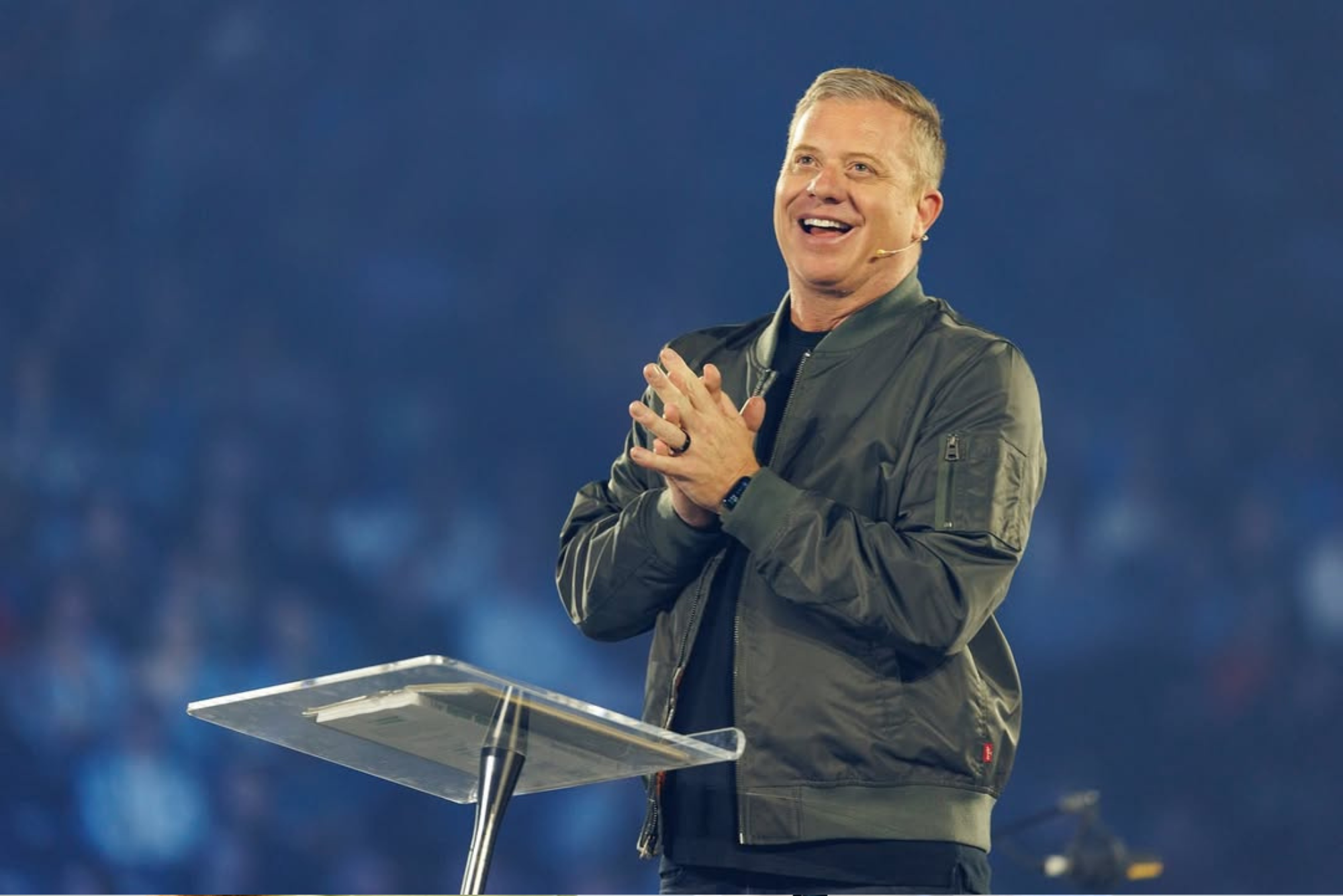
My first guest is Pastor Darren Whitehead, who founded Church of the City in Nashville and grew it to 10,000 people across four locations.
It’s easy to look at an outcome like this and believe it was part of a person’s grand plan all along. But Darren readily admits he’s not a long-term-plan kind of guy. Rather, his story is one of recognizing open doors and having the courage, flexibility, and faith to take risks and walk through them.
The Accidental Pastor: From Australia to the U.S.
Darren came from a small Australian town, raised in a tiny Baptist church. While he grew up Christian and had a solid foundation in his faith, sports were his real passion until he finished high school and moved to Adelaide (the nearest big city) for work. “That’s when I had this real opportunity to make faith my own,” he says. “I had a level of autonomy, an agency to either prioritize my faith or not.”
After meeting a group of peers with a passion for the things of God, Darren experienced what he describes as a spiritual awakening. “It gave me a different vision of what it would look like to be a young person of faith, where my faith was the most important thing to me,” he recalls.
At 19, he started working in Christian radio and then visited the United States to learn more about the industry. Months later, he looked into the possibility of coming to work in radio there. When he applied for the visa back at home, however, something unexpected happened.
“The INS officer who was reading my file misunderstood and made an administrative error,” Darren explains. “They gave me a pastor’s visa. I had never been a pastor, and I had no plans of ever becoming a pastor.”
Due to the confusing visa codes, Darren didn’t discover the mistake until after he moved to America. At that point, the only way he could stay was to become a pastor. Today, when people ask how he was called into ministry, he jokes: “I say the U.S. government called me into this, so out of fear of deportation, I just keep preaching every single week.”
DOWNLOAD OUR FREE EBOOK
Concierge Medicine is the future of healthcare.
Learn more about this refreshing alternative to traditional primary care, and decide if it's right for you.
Key Considerations to decide...
Is Concierge Medicine Right for You?
What could have been a discouraging bureaucratic disaster became a providential opportunity. While living with a Nashville family he’d met during his initial visit, Darren received an offer to become a paid intern to the youth pastor at the church they attended, Christ Church. After a year, the youth pastor moved on, and Darren was offered the job of leading the church’s student ministry.
“It was a surprise to me,” Darren admits of the whole experience. He didn’t understand why God would bring him to America to do something he could have done at home. “But honestly, it was like discovering my voice. It was like discovering who I am.”
Seeing middle and high school students light up spiritually and get a vision of using their lives to follow God delighted Darren. “I was just captivated by it, and have been ever since,” he says. “It felt like I was cooperating with the design that God had made for me.”
An Open Door: Formation at Willow Creek
As a person of faith, Darren wants to encourage others to pray both for God’s leading to their personal calling and for eyes to see it. He describes it as a convergence of your natural giftings, your passion, and an open door in your environment. “I’m so grateful that at the age of 23 I discovered that,” Darren says. “I want everyone to have that experience.”
One of those open doors appeared for Darren in 2001, when a parent of one of his youth group members approached him. “He said, ‘Hi, I’m Michael Smith,’ and I said, ‘No, you’re Michael W. Smith,’ and we became friends,” he recalls. After a year, Smith invited Darren to participate in recording a live worship album in front of 9,000 people. He asked Darren to walk out on stage mid-song, read Psalm 97, and pray. The album, which was released on September 11, 2001, sold 2 million copies.
That single moment opened doors. “It’s one of the most definitive moments of my life,” Darren says. “I ended up going on tour with Michael, and I met all these amazing people. That little moment is a thread that has connected so many different pieces of my life.”
One of those connections led to a job offer at Willow Creek Church in Chicago, a 30,000-member congregation and one of the most influential churches in America. But Darren knew his wife Brandy, a social worker and seventh-generation Tennessean, didn’t want to leave Nashville. “I thought, if my wife agrees to this, that is an act of God,” he recalls. “And she did.”
During his eight years in Chicago, Darren evolved from a college pastor to a teaching pastor on the senior leadership team. “It was one of the most crucial, most formative parts of my development,” he reflects. In particular, he learned how to lead a scaled organization, managing millions of dollars and hundreds of staff.
Open to Change: Planting in Tennessee
By his late 30s, Darren felt a need, a fire within, to lead something more. Though he considered staying at Willow Creek to take over as senior pastor, through discussion and prayer he decided to return to Tennessee, which thrummed with a multitude of the largely unchurched millennial generation. The decision made him nervous, but he began to make plans.
“I was praying about starting a church called Church of the City,” he says. When he looked up the domain name, he found a man in Arkansas owned it but wasn’t using it. He emailed the owner asking if he’d be willing to sell. The answer was no, though the owner said Darren could make him an offer.
In considering an amount, Darren thought, “$500 feels too little, and $1,000 is too much. So I’m going to split it down the middle.” He offered $750 for the domain and got an interesting response.
The owner shared that his wife had recently lost an envelope full of cash. Their daughter suggested, “Maybe we should pray that God would return the money to us.” His wife agreed, and the little girl asked how much money had been in the envelope. It was $750.
Both Darren and the owner took this as an open door from God, and the domain name changed hands.
With this and other confirmations behind him, Darren moved back to the Nashville area, planting two church locations on the same day. While carting chairs, a screen, and a projector back and forth every Sunday for two years, the church grew to 1,000 people and 15 staff.
At this point, Darren’s former church in the area, Christ Church, had lost their senior pastor and approached him about merging. The prospect sounded complex and intimidating, especially since the group was carrying $7 million in debt.
Not wanting to dismiss the idea out of hand, Darren decided to visit his longtime friend Dave Ramsey. “I thought he would say to stay away from that debt,” Darren recalls. “I said, am I crazy for even considering this?” But he was surprised by Dave’s answer: “The debt is not the reason to not do this. You just need to pay it off as quickly as possible.”
So, through a combination of prayer, discernment, and wise counsel, Darren and Church of the City decided to go ahead with the merger.
Darren found that the cost of maintaining the church’s debt was $1 million per year, and he wanted to free that up to pour into the community rather than into banks and interest. So, shortly after the congregations combined, he stood up and spoke frankly: “Our church has $7 million of debt. What if we just paid it all off? What if we aggressively, sacrificially, irresponsibly paid this off?”
What happened next was one of the most remarkable experiences of his life.
“No one gave us half a million dollars,” he says. “But we ended up having about 1,100 people say, ‘We want to be a part of this.’” Through giving small but sacrificial amounts, the church paid off that entire debt in 13 months.
An Audacious Idea: Building The Village
Over the next 10 years, Church of the City grew by roughly 1,000 people annually, reaching 10,000 by 2025.
The merger with Christ Church had given them a valuable 50-acre property just outside of Nashville. Darren says he would look out at 25 acres of unused green space and think about how Scripture portrays land as God’s gift, but one that requires work and investment to be worth anything.
“I thought, surely we’re supposed to do more than just mow this for the next 20 years,” he recalls. “What does God want out on this land?”
That led to a listening tour with local leaders, including the governor, mayor, chief of police, and social workers. Five main issues emerged: mental health support and suicide prevention, transportation for single parents, temporary foster placement, foster family recruitment, and support for the 1,000 kids aging out of foster care annually in Tennessee.
After consulting with experts and seeking what kind of facility could best serve these five needs, a vision emerged: The Village, inspired by the phrase “It takes a village to raise a child.”
The Village became a $50 million project, one Darren and Church of the City leadership were committed to building completely debt-free.
The goal seemed audacious, and certainly made some nervous. But Darren has a high threshold for ambiguity, and he started experiencing remarkable confirmation that they were on the right track from early on.
For instance, while the concept for The Village was still in its infancy stage, a couple who’d moved from California took Darren out to dinner. They asked what was in his heart for the future of the church, and he shared the early idea. Two days later, they offered $2.5 million in support. The next week, a Chicago family offered $1 million.
“We had three and a half million dollars, no plan, and I hadn’t asked anyone for money,” Darren says. “I thought, this is not an idea that I’m having, that I’m asking God to bless. This is a vision that God is having, that he’s asking me to join.”
Courage and Flexibility: Doing More Than Is Reasonable
Those early gifts gave Darren confidence for what came next: a fundraising dinner for 40 couples.
The morning of the dinner, he planned to ask for $6.5 million in donations, reaching a total of $10 million. But as he went over what he would share, something felt off.
“I’m so scared right now that 10 isn’t enough,” he told his wife, nearly in tears.
While Darren feared the attendees might think he was out of his mind, he was also sure that the number he was supposed to ask for wasn’t $10 million, but $15. “I was terrified,” he says. “This could be a colossal mess.”
But he did it. And that night, they raised $17 million. Thirteen families gave $1 million or more.
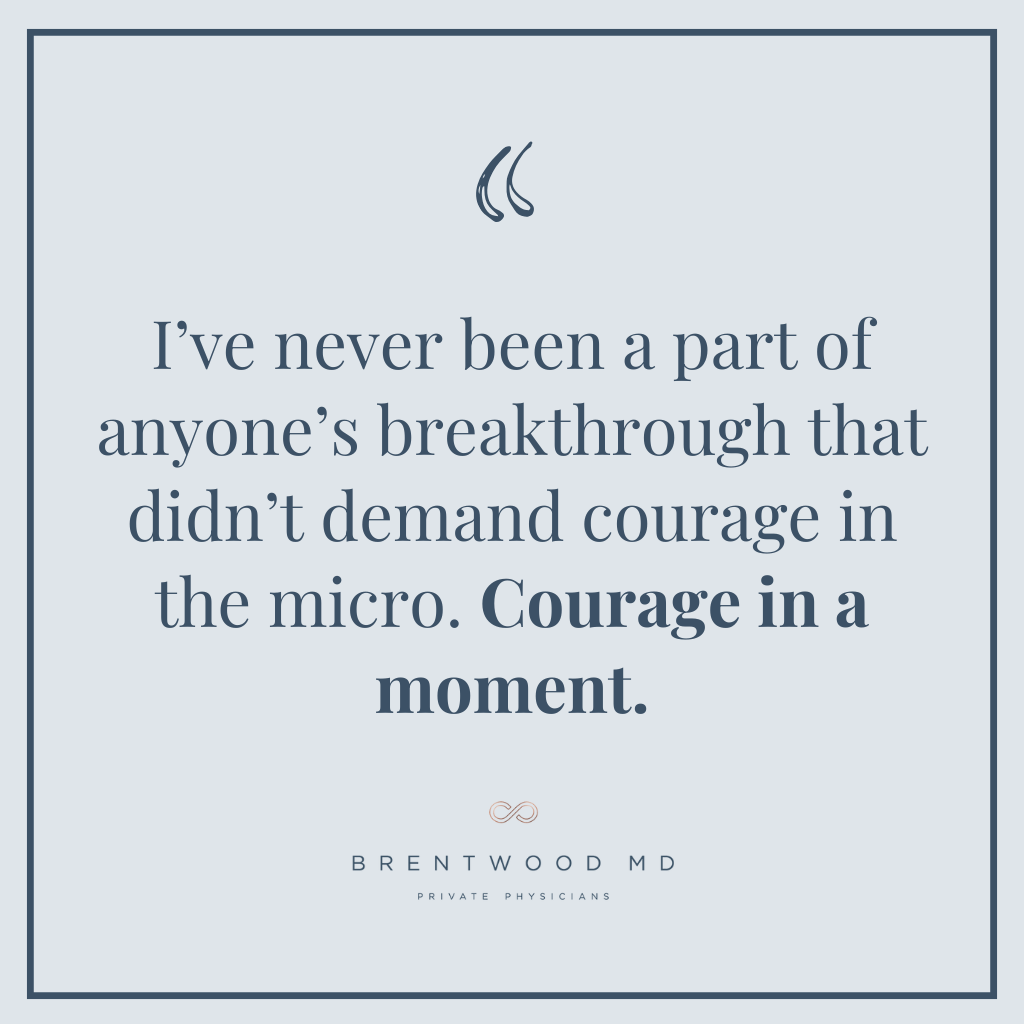
Personally, I’ve never been a part of anyone’s breakthrough that didn’t demand courage in the micro. Courage in a moment.
Darren’s courage had been building incrementally. Each risk prepared him for the next. Each time, the courage was intense but brief. And each time, he emerged with new capabilities.
Giving for The Village eventually grew to $50 million. As of our conversation, they have $42 million in hand, with $8 million committed before project completion in May 2026.
“I thought the $7 million paying off debt was going to be the most remarkable story I’ll tell for the rest of my life,” Darren says. “And it turns out we’ve raised $50 million since then.”
Hidden Costs: The Weight of Leadership
Building something at any scale comes with hidden costs.
When in crisis, people turn to spiritual leaders. Darren lives with a constant stream of heavy stories involving infidelity, divorce, accidents, cancer, and suicide. His children have grown up in proximity to this trauma, though he’s worked to let them see the blessing alongside the burden of his calling.
“I was absolutely committed to doing my best for my children to not hate the church or not resent the church as being the place that distracted their parents from them,” he says. “By God’s grace, my kids really love the church.”
The most difficult cost has been in relationships. When an organization scales from 100 to 10,000, the needs change dramatically. Small organizations need generalists. Large organizations need specialists.
A children’s ministry of 50 kids requires very different skills than one of 1,200 kids. As such, Darren has had to let people go who did nothing wrong.
Even more complex are Darren’s three-dimensional relationships as a pastor. In many cases, he’s both friend, boss, and pastor. And making a decision that’s right for an employee can feel like a violation of the friend or pastoral relationship.
“That has cost me a lot over the years,” he says. “I’ve lost some dear friends.”
Advice for Building: Know 3 Types of People
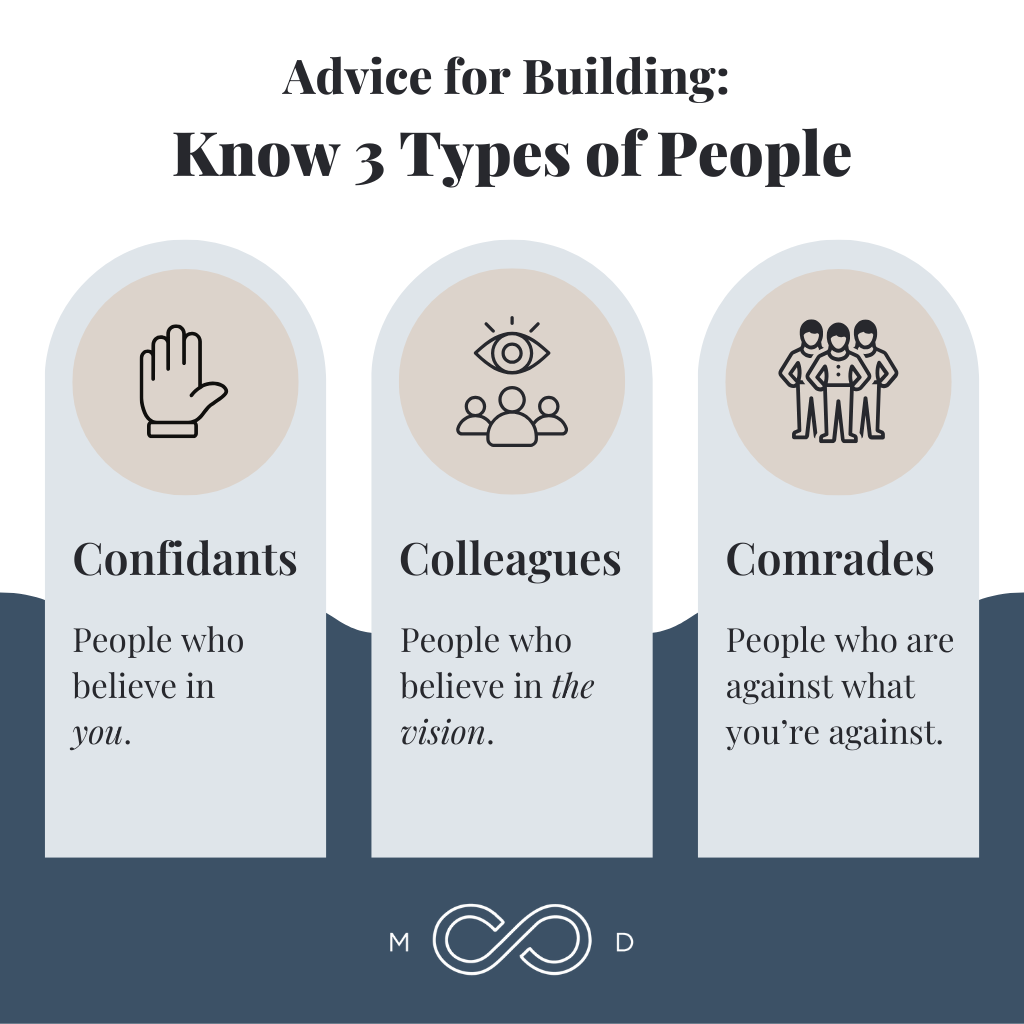
When asked what advice he would give his younger self, Darren talked about properly categorizing the types of people that surround what you’re building, your vision.
- Confidants are people who believe in you. They’ll walk with you no matter what.
- Colleagues are people who believe in the vision. They’re aligned with what you’re building, but if the vision changes, they may leave, because that’s not what they signed up for.
- Comrades are people who are against what you’re against. You’re bonded by opposition. These aren’t the ones you want involved in building because it can be quite destructive.
“If you don’t diagnose those correctly,” Darren says, “you open yourself up for a lot of pain and vulnerability.”
The danger develops mainly when you treat colleagues like confidants. When they move on, it hurts deeply because you’ve really let them in. You thought the relationship was about you when it was really about the work.
“All the pain in my life in the last 20 years has come from misdiagnosing confidants and colleagues,” he says.
This framework resonated with me. In medicine, as in ministry, leadership is deeply relational. Learning to properly categorize relationships isn’t cynical. It’s wisdom that protects both parties and honors the true nature of the connection.
Looking Back in Gratitude
Looking back at his and his wife’s journey over the years, Darren says that it’s gone better than they ever could have imagined. “One of the defining themes of our life and our marriage is gratitude,” he says.
For his wife, her passion as a social worker advocating for vulnerable children has manifested in this enormous, tangible project of The Village. “I joke that The Village is what happens when a youth pastor and a social worker get married,” Darren says.
For him, he’s found his calling, what he was made for, and he’s taken the necessary risks to follow it through. He holds fewer strong opinions than he once did on non-essentials, but he’s more confident than ever in his intuition and in discerning God’s voice.
“We don’t think it’s us,” he says. “We think it’s the kindness of God. It’s extraordinary people who have joined us along the way. And when you get extraordinary people, more extraordinary people want to be a part of it.”
You can learn more about Darren’s work at cotc.com or churchofthecity.com. His latest book is available at thedigitalfast.com.
Whether you’re a person of faith or not, Darren hopes his story provides both inspiration and insight. And if you’re not a person of faith, he invites you to “take a risk and pray, ‘God, if you’re real, would you show me?’ and see what he does.”
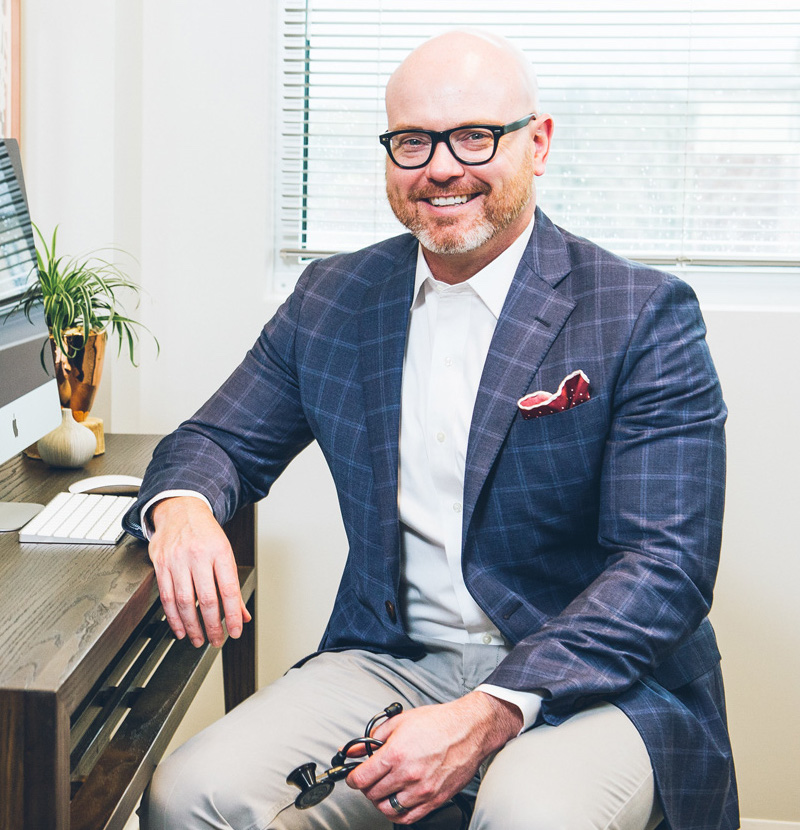
Dr. Aaron Wenzel is a concierge physician specializing in the care of fast-moving entrepreneurs, executives, and public figures in the Nashville, TN area. Dr. Wenzel’s diverse life experience and extensive training in family medicine, emergency care, nutrition, and hormone replacement therapies give him the unique platform to provide unmatched care for his patients.

Dive deeper into maximizing your lifespan and healthspan with Dr. Aaron Wenzel’s new book.