Back in the early 2000s, everyone seemed to be talking about creatine. Or at least, everyone who spent lots of time in the gym. Then, it disappeared from the public consciousness, fading into the hazy abyss of supplements gone by.
But the research never stopped.
Scientists continued to study creatine throughout those quiet years, their findings positioning it to come back with a vengeance. And it has.
If you’re on social media, you might have seen friends, influencers, or health accounts talking about the addition of creatine to their supplement stack. Not because it builds biceps while they sleep, but because it amplifies the effort they’re already putting in.
So, let’s talk about how creatine works, the potential benefits of creatine (both muscular and otherwise), and whether this well-studied supplement might be a good option for you.
How Does Creatine Work?
Your body naturally produces creatine in the liver, kidneys, and pancreas, storing it primarily in your muscles and brain. But how does creatine actually work?
You may remember adenosine triphosphate, or ATP, from high school biology as the energy currency of the cell. When an ATP bond breaks, it releases energy that your body uses for everything from lifting weights to thinking clearly. You’re then left with adenosine diphosphate, or ADP, which your body works to convert back into ATP for further energy supply.
Creatine helps your cells rapidly recycle ADP back into ATP, providing increased capacity for high-demand work.
We get some creatine from our diet, especially from red meat and seafood. But supplementing with creatine can increase intramuscular stores by up to 20–40%, depending on your starting point. That’s a significant boost, helping drive performance and deliver meaningful health benefits.
The Benefits of Creatine
Muscle and Performance
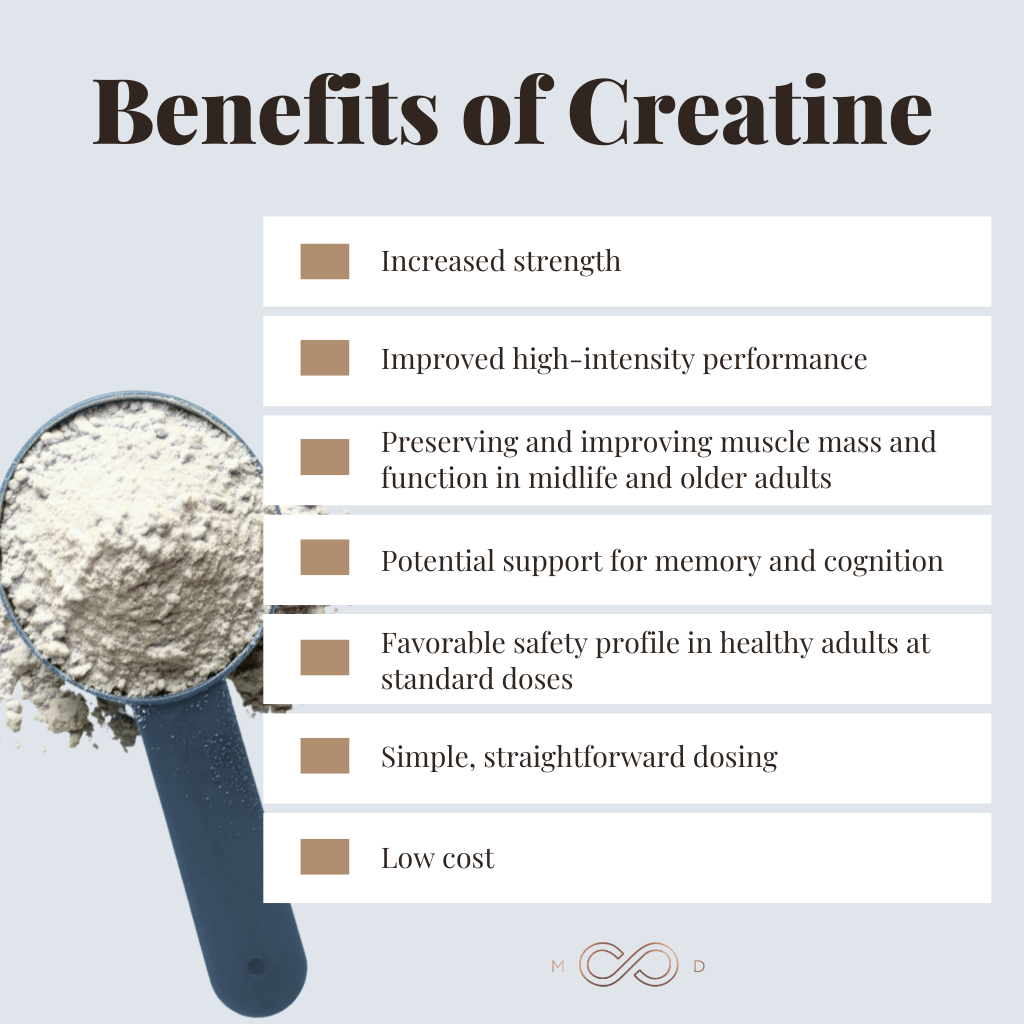
Evidence strongly supports creatine’s benefits for strength and high-intensity performance. Studies show supplementing with creatine may allow you to lift heavier, complete a few more reps, and recover more quickly between sets. Over time, this supports strength and lean muscle mass development, as well as helping to counter age-related muscle loss.
Sarcopenia, or age-related muscle loss, is one of the biggest threats to quality of life as we age. Maintaining muscle mass and strength, therefore, becomes increasingly important in midlife and beyond.
Unfortunately, many older adults consume less than a gram of dietary creatine daily, and perhaps none at all if they’re vegan or vegetarian. This low intake is associated not only with reduced muscle mass but also with reduced cognitive function. Consequently, the relative benefit of creatine supplementation may be largest for older populations.
Brain Health and Cognition
While emerging research on creatine and cognition is promising, I’d characterize it as suggestive rather than conclusive. Some studies indicate that creatine supplementation supports short-term memory and reasoning, especially under conditions of high brain energy demand. Your brain needs energy to function at its best, and creatine appears to potentially provide that fuel.
Systematic reviews in older adults also suggest possible benefits for attention cognition, though the data remains limited.
This is an area where we need more research. The signals look good, but it’s premature to call creatine a slam-dunk cognitive enhancer. Still, given its strong safety profile and muscular benefits, the potential brain health advantages make creatine even more interesting for older adults.
Simplicity
At standard dosing, creatine is straightforward, relatively inexpensive, extensively studied, and safe for most healthy adults. Not many supplements can boast all that alongside such significant benefits for overall health.
Who Should Consider Creatine
Creatine makes sense for several groups, assuming no contraindications. Recreational and competitive exercisers who do resistance training, high-intensity interval training (HIIT), or sports requiring short, explosive effort are certainly good candidates.
Adults concerned about sarcopenia, particularly those in middle age and beyond who are willing to do resistance training, should consider talking with their doctor about creatine supplementation as well.
People with lower dietary creatine intake, such as those eating little or no meat, may see larger relative benefits of supplementation. Someone already eating a lot of meat will have higher baseline creatine stores, so the impact of supplementation may be less dramatic (though still present).
Who Should Avoid Creatine
Despite its benefits, creatine supplementation does have some clear contraindications:
- Known significant kidney disease or a history of kidney impairment
- Highly complex electrolyte disorders
- Age under 18
- Pregnant or breastfeeding
I recommend speaking with your doctor before beginning any new supplement regimen. They should know your history and health conditions, and they can consider whether a particular supplement might prove helpful or harmful in your specific situation.
Creatine and Kidney Damage: Dispelling the Myth
Some worry that elevated creatine levels could cause kidney damage, but this may stem from a confusion over the terms “creatine” and “creatinine.”
The words look and sound similar, but they aren’t the same. Creatinine is a waste product produced by your muscles as they metabolize creatine. High levels do indicate an underlying kidney issue, but not because you have too much creatine.
While creatine supplementation can raise creatinine levels slightly due to increased production and metabolizing, this doesn’t equal kidney injury in healthy adults. In fact, long-term safety data shows no clinically meaningful decline in kidney function at recommended creatine doses. The research is reassuringly clear on this point.
Common Side Effects of Creatine
The most common side effect of creatine supplementation is small, early weight gain, typically one to three pounds, from increased water retention in the muscles. This usually lasts a couple of months and then normalizes.
GI upset is another issue some people contend with, particularly when taking loading doses. Loading involves taking about 20 grams per day (divided into four doses) for five to seven days, then transitioning to five grams daily. People who load typically experience more GI side effects than those who don’t.
How to Take Creatine: Dosing and Type
The best-studied form of creatine is creatine monohydrate. Other forms exist, like buffered creatine and ethyl ester, but they’re more expensive with no clear superiority. Since most studies have been done on creatine monohydrate, I suggest sticking with that and finding a product that’s third-party tested for quality.
As mentioned above, some people like to “load” creatine to build up their intramuscular stores quickly, but this leads to GI upset. I suggest sticking with five grams once per day with a meal or before or after a workout. This reaches similar muscle saturation in a few weeks and is much easier on the GI tract.
Taking your creatine daily is beneficial, but you don’t need to worry if you miss a dose since intramuscular stores decline slowly.
If you’re taking creatine long term, baseline renal function testing makes sense as part of your annual check-up to monitor kidney health. If you develop a kidney issue (not from taking creatine), you’ll want to be aware so you can stop supplementation.
The Bottom Line on the Benefits of Creatine
Creatine isn’t a magic pill that grows miracle muscles all on its own, but it is a helpful adjunct to resistance training for preserving and improving muscle mass and function, particularly in midlife and older age. The emerging but promising support for brain health adds another dimension to its appeal.
But here’s what creatine isn’t: a substitute for resistance training, adequate protein intake, quality sleep, or an overall healthy lifestyle. Creatine amplifies good habits; it doesn’t replace them.
If you’re already healthy and involved in strength training, creatine might be a good tool to discuss with your doctor. For many of our members at Brentwood MD, this could be something that gives you an extra 3 or 4% improvement each year, helps you recover better, and makes you more explosive in the gym.
The gains don’t come overnight. They compound over time. That’s the real power of a well-chosen supplement combined with consistent effort.

Dr. William Pierce is a board-certified Family Medicine physician with experience in Emergency Medicine who joined Brentwood MD in 2025. He specializes in providing comprehensive, personalized care that combines preventive health strategies with acute medical expertise. Dr. Pierce is committed to building enduring patient relationships grounded in trust, clinical excellence, and collaborative health management.