
If you’re losing weight, where does your fat go?
I’ve heard all kinds of answers to this question. It gets sweated out. It turns into muscle. It just… disappears. But the real answer surprises almost everyone: You literally exhale it. (Or, most of it.)
That’s not a metaphor or an oversimplification. It’s biochemistry.
Understanding how fat leaves the body can change the way you think about fat loss, and more importantly, reveal why some people struggle to lose fat even when they’re doing everything “right.”
So, how does fat leave the body? Let’s break down the science, the obstacles, and the strategies that work.
How Does Fat Leave the Body?
To understand how fat leaves the body, we first need to understand how fat is stored in the body.
All throughout our bodies, balloon-like cells called adipocytes store energy from excess calories as fat molecules. These molecules, called triglycerides, are made up of free fatty acids and glycerol, which are in turn composed of carbon, hydrogen, and oxygen.
When your calorie intake falls short, your body needs to get energy from somewhere else. Your hormones trigger a process called lipolysis, which breaks down stored triglycerides into their component parts. One of those parts, the fatty acid, is transported through the bloodstream to cells that need energy, where it’s oxidized for ATP inside the mitochondria.
That oxidation process produces two waste products: carbon dioxide and water.
Research shows that when you lose 10 kilograms of fat, 8.4 kg of that mass exits your body as exhaled carbon dioxide, and 1.6 kg leaves as water through urine, sweat, and breath. That makes your lungs the primary exit route.
So every breath out during fat loss carries away the molecular byproducts of burned triglycerides.
Understanding how fat leaves the body reframes the entire fat-loss conversation. While watching your calorie intake can certainly be helpful, fat loss isn’t a simple calories-in, calories-out equation. Hormones, chemical reactions, and a whole complicated process are involved.
The question then shifts from “how do I eat fewer calories?” to “what’s helping or hindering my body from consistently burning fat for fuel?”
What Inhibits Fat Loss?
While multiple factors can interfere with fat loss, the biggest culprit for a significant portion of the population is insulin resistance.
In a healthy, insulin-sensitive body, insulin rises after a meal, shuttles the resulting glucose from the bloodstream into adipose cells for storage as triglycerides, and then falls. That drop in insulin is the hormonal green light for lipolysis to begin.
Elevated insulin tells your body to store fat. Low insulin allows your body to freely break down stored fat for energy. Under normal circumstances, this facilitates a healthy balance between energy storage and usage.
Insulin resistance throws that balance off.
When cells stop responding to insulin properly, they’re more reluctant to take in glucose for storage. Blood sugar remains elevated, so the pancreas compensates by producing more insulin to force the cells to cooperate.
The result is a chronically elevated baseline insulin level, which applies a constant brake pedal to lipolysis. As a result, you aren’t burning fat throughout the day, even if you haven’t eaten in hours.
Now we can see why insulin-resistant individuals tend to lose less fat and more lean mass during calorie restriction than insulin-sensitive individuals, even when both follow the same diet. A calorie deficit exists on paper, but the hormonal environment means the body struggles to switch over to fat-burning mode.
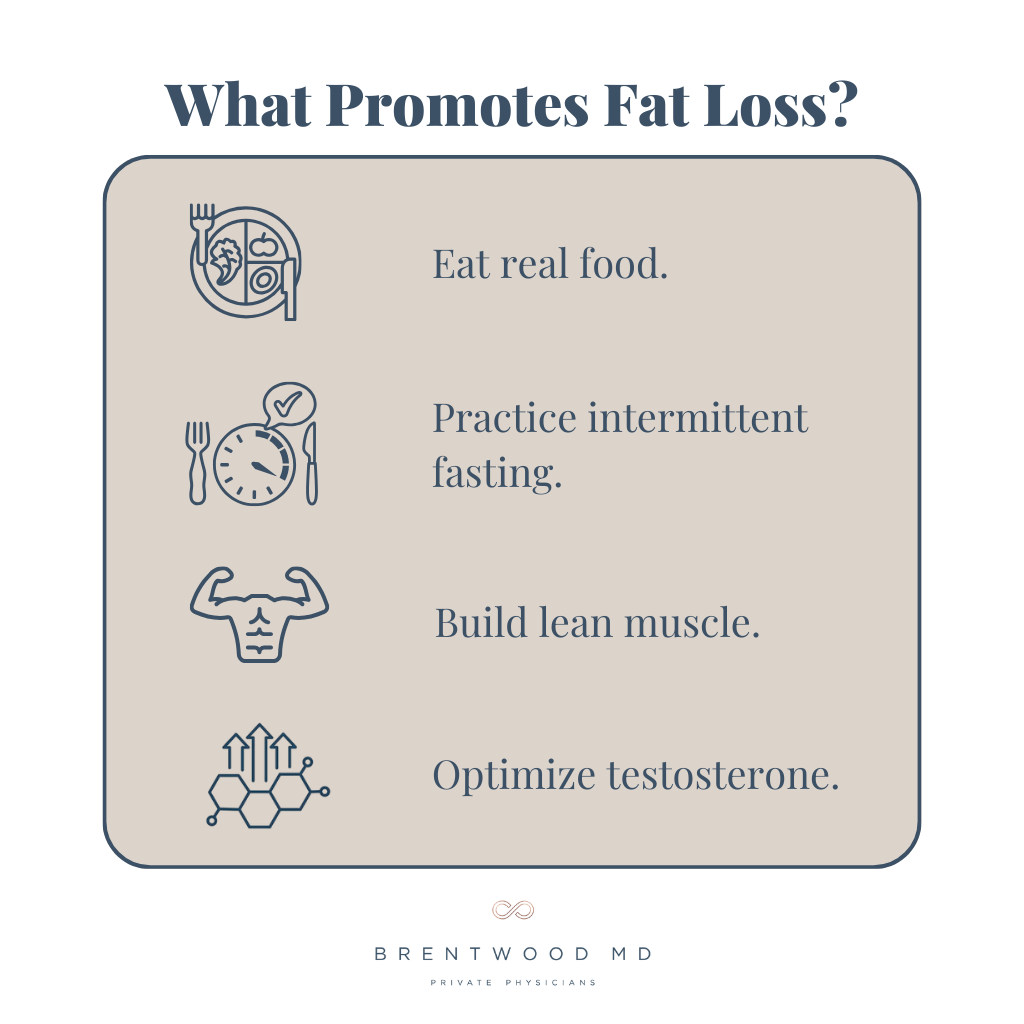
What Promotes Fat Loss?
When you take in fewer calories than your body expends, you create an energy gap that triggers lipolysis. That’s the foundation of fat loss… in a pristine metabolic environment.
But as we’ve seen, a calorie deficit alone isn’t always enough, especially when hormones go awry. Thinking of weight loss as purely a math problem ignores the biochemical context that determines whether the alternative energy you need comes from fat or from other sources, like lean muscle.
For those with insulin resistance, a crucial component of consistent and long-term fat loss is improving insulin sensitivity. When insulin sensitivity improves, baseline insulin drops, lipolysis runs more freely, and the same calorie deficit actually produces results.
Due to our modern environment of abundance, the vast majority of Americans fall into the insulin-resistant category. To combat and even reverse this, here are some strategies that work:
- Eat real food. Refined carbohydrates and processed foods spike blood sugar rapidly, keeping insulin elevated throughout the day. A diet built around whole, minimally processed foods keeps glucose steady and gives insulin levels a chance to normalize. Remember: If it wasn’t food 120 years ago, it isn’t food now.
- Practice intermittent fasting. With all the snacks and social engagements of modern life, it’s easy to eat almost constantly, keeping insulin levels high. But intentionally extending the window between your last meal at night and your first the next day gives your body prolonged stretches of low insulin, during which lipolysis can run unimpeded. My quick-start guide to intermittent fasting walks through how to make that work for your schedule.
- Build lean muscle. Skeletal muscle is metabolically active tissue. It consumes glucose directly during exercise, reducing the insulin burden on your body, and it raises your resting metabolic rate. Strength training is one of the most powerful tools for restoring insulin sensitivity and improving body composition simultaneously.
- Optimize testosterone. Testosterone plays a direct role in metabolic health, lean mass maintenance, and insulin sensitivity. Low testosterone is a common and underappreciated factor in stubborn fat gain, particularly around the abdomen. When appropriate, bioidentical testosterone replacement therapy can support proper metabolism in both men and women.
By pulling these levers, alone or together, your biochemical environment shifts. Insulin levels come down, lipolysis opens up, and fat oxidation accelerates. Your lungs start exhaling more of those carbon dioxide byproducts, and the scale reflects the change.
Weight Loss Myths: How Fat Does NOT Leave the Body
Finally, let’s clear up two common myths about fat loss.
The first is a mistaken idea that fat becomes muscle when you work out. Fat does not miraculously convert into muscle. Muscle and fat are entirely different tissues. So while you can lose fat and build muscle at the same time, one doesn’t convert into the other.
The second myth is that lots of sweating means lots of fat loss. Yes, your body does excrete a fraction of fat byproducts in the form of water, but that’s the end result. Forcing yourself to sweat more, whether in a sauna or under layers of heavy clothing, just imitates that end result rather than facilitating the fat-loss chemistry that leads to it.
That said, increased heat may require slightly more energy consumption from your body, which could induce a small bump in fat loss. But you’re still mainly losing water weight.
How Does Fat Leave the Body? The Bottom Line
Our bodies’ fat-loss process is elegant, efficient, and even a bit counterintuitive. Who knew fat left the body through the lungs?
But when the body stops cooperating due to imbalances like insulin resistance, we have a problem. Fat begins to accumulate. Calorie restriction stops working. Blood sugar climbs.
The issue often isn’t effort. It’s biochemistry. But understanding how fat leaves the body allows you to take steps that actually address the underlying problem and make real progress.

Dr. Aaron Wenzel is a concierge physician specializing in the care of fast-moving entrepreneurs, executives, and public figures in the Nashville, TN area. Dr. Wenzel’s diverse life experience and extensive training in family medicine, emergency care, nutrition, and hormone replacement therapies give him the unique platform to provide unmatched care for his patients.