
You slept last night. No, really, you did. Maybe not eight hours, but at least six.
So why do you feel like you barely slept at all?
For a lot of people, especially high-performing professionals, this is a familiar frustration. You lead a busy life, and sleep doesn’t always win the battle for priority. But it’s not as if you’re pulling all-nighters. So why doesn’t your rest seem to be benefiting you?
We all pass through sleep stage cycles every night, and how long we spend in each cycle affects how restorative our sleep is.
The most physically restorative stage of the sleep cycle is called deep sleep, and when you don’t get enough of it, the consequences show up everywhere, from energy and mood to metabolism and long-term health.
The good news is that you can learn how to get more deep sleep by employing a few strategic adjustments. Here’s what you need to know.
How Much Sleep Do You Really Need?
As a busy adult with lots of demands on your time, you may be hoping for a shortcut that makes a few hours of sleep equal to a full night’s rest. But all progress starts with telling the truth, and I’m here to tell you that sleep just refuses to work like that.
By far, the most important, baseline adjustment most people need to make to improve the quality of their rest is to get more of it.
In general, adults need between seven and nine hours of sleep per night for optimal health. And no, six hours is not enough, regardless of how adapted you feel to it.
“But wait, Dr. Wenzel! What about short sleepers?”
Yes, “short sleepers” are a thing, but I can almost guarantee you aren’t one of these exceedingly rare individuals.
Short sleepers genuinely thrive on less sleep, usually between four and six hours. In fact, they can’t sleep more even if they want to. The trait often runs in families, and it affects only a tiny fraction of the population. For everyone else, insufficient sleep is just insufficient sleep, no matter how normalized it feels.
With that out of the way, we can move on to why sufficient sleep is so important.
If you’ve ever used a sleep tracker, you’ve probably noticed that sleep works in cycles. Your body and mind move through all the sleep stages repeatedly during the night, so you don’t get the full amount of any specific stage all in one chunk. You have to sleep a full night to pass through all the crucial stages a sufficient number of times for restoration and recovery.
Take deep sleep, also called N3 or slow-wave sleep, for example. This sleep stage makes up about 10–20% of a person’s nightly rest, working out to about one to two hours on an ideal night. If you’re only sleeping five or six hours to begin with, however, you don’t give your body enough runway to accumulate adequate deep sleep.
Why Deep Sleep Matters
Each sleep stage has an important role to play. REM sleep, the stage associated with dreaming, plays an important role in memory and emotional processing. Light sleep aids in memory storage as well as creativity. But deep sleep is where the heavy physical lifting happens.
During deep sleep, your body repairs tissues, builds bone and muscle, strengthens the immune system, and releases key hormones, including growth hormone. Your brain uses this stage to consolidate memories and clear out metabolic waste that accumulates during waking hours. So when you shortchange deep sleep, you feel it.
Too little deep sleep (or REM sleep) is linked to insulin resistance, weight gain, elevated cortisol, depression, anxiety, poor memory, reduced impulse control, diminished sex drive, heart disease, and type 2 diabetes. The long-term stakes are significant.
Chronic sleep debt doesn’t just leave you tired. Over time, it produces disease.
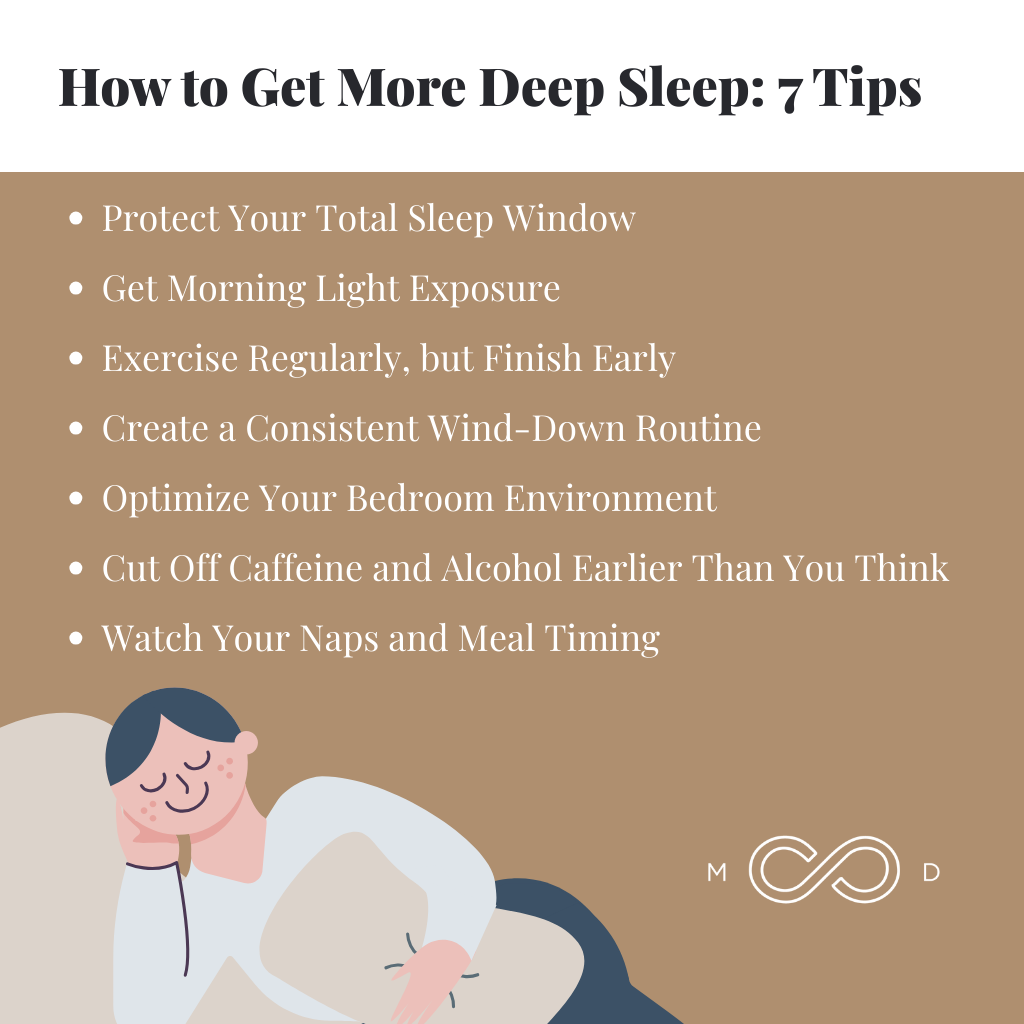
How to Get More Deep Sleep: 7 Tips
The following tips offer insight on how to get more deep sleep, but remember that anything that benefits deep sleep will likely benefit all the other sleep stages as well.
1. Protect Your Total Sleep Window
Deep sleep can’t be optimized if the foundation isn’t there. Getting enough sleep, between seven and nine hours a night, is crucial and requires more effort and prioritization than people often realize.
Everything else can seem more important than sleep; after all, everything else happens when you’re conscious. But protecting your bedtime and sleep quality protects your ability to function during the two-thirds of your life when you’re awake.
Going to bed and waking up at the same time every day, including on weekends, plays a role in this protection. Consistent sleep and wake times keep your circadian rhythm stable and help your body spend more time in restorative sleep stages. Even a two-day deviation on weekends can require several days to correct, causing your rest to suffer in the meantime.
2. Get Morning Light Exposure
Exposure to natural light early in the day helps anchor your circadian rhythm, which in turn signals your body to drop into deep sleep at the right time each night. Even a short walk outside within an hour of waking can make a meaningful difference in your ability to fall asleep more quickly.
3. Exercise Regularly, but Finish Early
Regular physical activity is one of the most reliably effective ways to increase deep sleep. Aim for at least 150 minutes of moderate exercise per week, plus strength training.
One important caveat: Vigorous exercise raises your core body temperature and heart rate, both of which work against sleep onset. To avoid delaying quality sleep, finish intense workouts at least three to four hours before bed.
4. Create a Consistent Wind-Down Routine
One of the most common complaints I hear from members is an inability to shut their brain off at night. They’ve been going at a high level all day, and now they suddenly need to shut down.
But your nervous system doesn’t just flip a switch at bedtime. It needs a runway.
Checking emails and/or working on tomorrow’s presentation raise cortisol levels and delay the brain in getting to a sleep state. Calming pre-sleep activities like reading (not in bed), light stretching, breathing exercises, meditation, and prayer signal to your brain that the day is winding down.
If a racing mind is your primary obstacle, building in 10–15 minutes of journaling or focused breathing as a fixed pre-sleep step can be especially useful.
5. Optimize Your Bedroom Environment
Three environmental factors consistently show up in research on optimized sleep: darkness, quiet, and cool temperature.
- Sleep in a pitch-black room. Use blackout curtains or a sleep mask if needed.
- Make the room as quiet as possible. Any noise can interrupt your sleep stages even if you don’t consciously notice it.
- Keep the room cool, ideally in the mid-to-upper-60s Fahrenheit. Your core body temperature naturally drops during sleep, and a cooler room supports that process.
6. Cut Off Caffeine and Alcohol Earlier Than You Think
Caffeine consumed even six to eight hours before bed can fragment your sleep and reduce time in REM and deep sleep. Consider auditing your caffeine intake, especially the timing, and experimenting with earlier cutoff times.
Alcohol forms a different trap for sleep. Though it makes you feel sleepy and, therefore, seems like a tempting sleep aid, alcohol actively suppresses deep and REM sleep and increases nighttime awakenings. It essentially destroys the proper progress of sleep stages, resulting in inadequate rest and repair.
The research on alcohol and sleep quality is unambiguous on this point. So, if you drink, give yourself at least one hour per drink before going to bed. More buffer is even better.
7. Watch Your Naps and Meal Timing
Think of your need for sleep as a jar filled with sand. After a night of sleep, the jar is full. As the day progresses, more and more of that sand disappears. By nighttime, the jar is empty and needs to be refilled.
Long or late-day naps put sand back in the jar before bedtime, reducing your body’s accumulated drive for deep sleep at night. So if you nap, keep it to 20–30 minutes and earlier in the afternoon.
Similarly, finishing heavy meals at least three to four hours before bed allows digestion to wind down. Otherwise, your body temperature and metabolism remain elevated when they should be dropping into sleep mode.
How to Get More Deep Sleep: Final Thoughts
Sleep is a powerful health multiplier. Even a 2% improvement in sleep every night, compounded over a year, represents an enormous gain in recovery, performance, and long-term health. And unlike many health interventions, better sleep (usually) costs nothing.
Start with one or two changes from the “how to get more deep sleep” list above and give them two to three weeks to take hold. I suggest tracking your results with a wearable device, like the Oura Ring, Garmin watch, or Apple Watch, and adjusting from there.
If you’ve tightened up your habits for several weeks and still wake up unrefreshed, or if you or your spouse have noticed loud snoring, gasping, or significant daytime sleepiness, that warrants a conversation with your physician to rule out more serious issues like sleep apnea.
Deep sleep isn’t a luxury. It’s the foundation everything else is built on. Guard it accordingly.

Dr. Aaron Wenzel is a concierge physician specializing in the care of fast-moving entrepreneurs, executives, and public figures in the Nashville, TN area. Dr. Wenzel’s diverse life experience and extensive training in family medicine, emergency care, nutrition, and hormone replacement therapies give him the unique platform to provide unmatched care for his patients.