
For men looking to optimize their testosterone levels, the conversation usually revolves around pellets, creams, gels, or injections.
Exogenous testosterone, or testosterone delivered from outside the body, has essentially been the only game in town for decades. But in the last few years, a compelling alternative emerged: enclomiphene.
This new drug offers a completely different pathway for increasing testosterone while avoiding some of the potential side effects of traditional testosterone replacement therapy (TRT).
So, what is enclomiphene, who is it for, and what are the possible risks? Let’s break it down.
What Is Enclomiphene?
Let’s start with that first question: What is enclomiphene?
At its core, enclomiphene is an oral medication in the selective estrogen receptor modulator (SERM) family. Rather than delivering synthetic testosterone from the outside in, enclomiphene helps your body increase its own testosterone production. It works upstream, at the brain level, supporting your natural hormone axis’s activity instead of replacing it.
Enclomiphene was developed from clomiphene, or Clomid, a medication that’s been FDA-approved for treating female infertility since 1967. Clomiphene is made up of two molecular isomers. To get enclomiphene, scientists essentially removed one of those isomers (the one responsible for unwanted estrogen-related side effects in men). What remains is a more targeted, better-tolerated molecule for male hormone optimization.
You might be wondering, how could an estrogen-related drug help with a man’s testosterone production? It’s a good question.
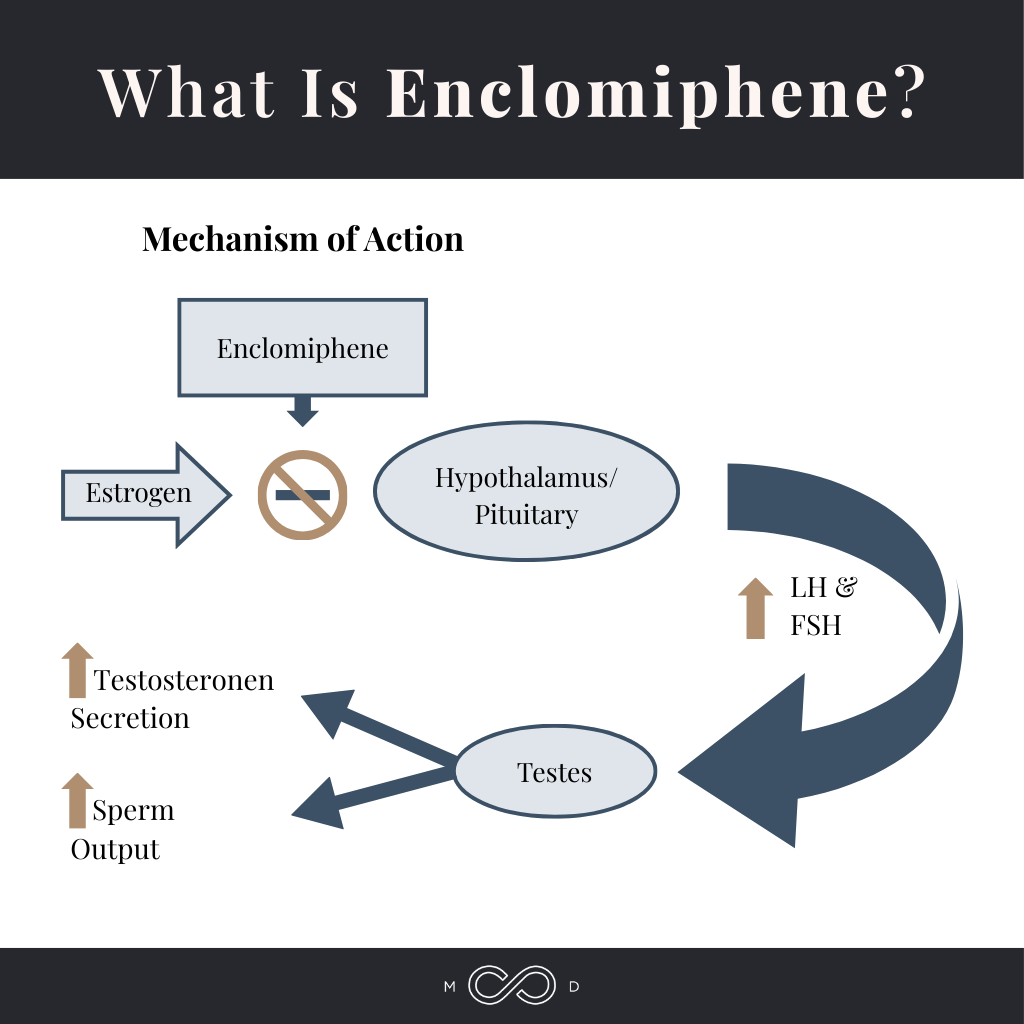
Just as women produce some testosterone, men also produce some estrogen. Mostly, male estrogen comes from excess testosterone being converted to estrogen. The presence of that estrogen tells the hormonal command center in your brain (the hypothalamus along with the pituitary gland) that your body is all set on testosterone. The pituitary then reduces its production signals to the testes, and your hormones balance out.
DOWNLOAD OUR FREE EBOOK
Concierge Medicine is the future of healthcare.
Five honest questions to help you decide, plus a clear look at how membership medicine differs from the care you have now.
THE CONCIERGE MEDICINE GUIDE
Is Concierge Medicine Actually Right for You?
However, certain other factors can also result in excess estrogen production in a man’s body. Chronic stress or excess body fat, for example, lead to increased estrogen, which in turn leads to reduced testosterone.
Enclomiphene vs. TRT
This is where it’s helpful to see the distinction between enclomiphene vs. TRT.
Traditional TRT, regardless of the delivery mechanism, is a “replace and risk” approach. To bring testosterone levels back up to normal, you flood the body with hormones from an external source. It does work, but it also signals to the brain that testosterone is already high. As a result, the brain stops telling your testes to produce testosterone. Over time, this can suppress natural production significantly and sometimes permanently. In some cases, it can cause infertility.
Enclomiphene takes the opposite approach. By blocking estrogen’s negative feedback signal at the pituitary, it tricks the brain into thinking estrogen is low, prompting the release of gonadotropin-releasing hormone (GnRH), luteinizing hormone (LH), and follicle-stimulating hormone (FSH). LH then stimulates the testes to produce more testosterone, while FSH supports sperm production. The whole axis stays online. This is a “restore and preserve” strategy.
Why Fertility Matters (Even if You’re Not Planning for Children)
The enclomiphene vs. TRT conversation is especially important for men in their 20s, 30s, 40s, and even 50s.
Traditional TRT can suppress sperm counts significantly and sometimes drive them to zero. For men who want to have biological children, even if it’s later in life, that’s an enormous risk to take unnecessarily. Because enclomiphene stimulates LH and FSH rather than suppressing them, sperm production is maintained and often improved while testosterone rises.
But here’s what I tell patients who aren’t thinking about having kids: Fertility is just one piece of the picture. The bigger point is that you’re preserving your body’s own machinery and not creating a dependency on an external hormone source. Keeping your hypothalamic-pituitary-gonadal axis active is, simply put, healthier.
The benefits of bringing testosterone levels to the higher end of the normal physiologic range are also real.
A “normal” free testosterone level, for instance, ranges from 50 to 225 pg/mL. If you’re sitting at 60 pg/mL, which is technically normal but nowhere near optimized, we can often double or even triple that level. It’s still completely within normal range, but many men notice a significant difference in how they feel: increased energy, improved libido, reduced body fat, lean muscle growth, stronger bones, better mood, and/or enhanced cognitive function.
One additional practical advantage of enclomiphene is how you take it: by mouth, once a day. No procedures, no twice-daily creams, no injections multiple times a week. It’s a simple option that’s easy to build into your routine.
Who Is a Good Candidate for Enclomiphene?
When evaluating whether someone is a good fit for enclomiphene, one of the first things I look at is FSH and LH levels, both of which normally range from 1 to 10 in men. If someone is sitting at a 2, that tells me their signaling pathway is on the lower end of normal and that there’s room to amplify it. If we can bring that signal up to a 6, 7, or 8 with enclomiphene, we’ll meaningfully increase their natural testosterone production.
Enclomiphene works best when the underlying issue is a signaling problem. This means the testes have the capacity to produce testosterone; they’re just not getting the full message. In younger men, I find this is often what’s happening. The machinery works, but the signal is suppressed, often by elevated estrogen from excess body fat or chronic stress.
Men who carry extra body fat or live high-stress lifestyles convert more testosterone into estrogen than leaner, lower-stress individuals. That elevated estrogen feeds back to the brain and further dampens the signal to the testes. It’s a cycle that’s difficult to break without resetting the pathway, which is what enclomiphene is designed to do.
For older men, those in their 70s for instance, the signaling pathway may be functioning well, but the testes themselves are simply no longer as responsive. In those cases, TRT with exogenous testosterone is often the more appropriate route.
Enclomiphene: Safety, Side Effects, and What We Monitor
First, it’s important to know that enclomiphene is not currently FDA-approved for male testosterone optimization. However, doctors are allowed to prescribe it off-label and source it through a compounding pharmacy.
Side effects are generally mild and relatively uncommon. A small percentage of users, roughly 1–3%, may experience headaches, mild nausea, or GI upset. Mood changes or irritability are possible, mainly if testosterone levels get too high. Rarely, some men notice visual disturbances such as blurred vision or light sensitivity.
Like exogenous testosterone, enclomiphene can cause secondary erythrocytosis, meaning increased red blood cell production and increased clotting risk. At Brentwood MD, we monitor blood counts regularly in members on enclomiphene or TRT for this reason. For men with known clotting disorders or active cancers, we have a detailed conversation on risks vs. benefits and risk mitigation before starting.
For all these reasons, I strongly recommend only taking enclomiphene while under the care and monitoring of a knowledgeable physician. We’re able to assess enclomiphene’s suitability for your specific situation, monitor your risk factors, and source the drug from a pharmacy that follows rigorous quality standards to ensure consistent dosing, freedom from contaminants, and proper compounding protocols.
What Is Enclomiphene? Final Thoughts
What is enclomiphene, at the end of the day? A clinically compelling option for men who want to boost testosterone naturally, preserve their body’s own hormone-producing machinery, and keep their options open for the future.
I’ve seen truly excellent results in members taking enclomiphene. Their testosterone levels have improved significantly, and (more importantly) they feel better: more energy, better performance in the gym, quicker recovery, and improved quality of life all around.
But no magic pill exists in health. Enclomiphene functions as a powerful tool inside a broader, individualized plan. It supports and multiplies your efforts in other areas, such as nutrition and fitness, but it doesn’t replace them.
The decision to use it requires a careful evaluation of symptoms, labs, fertility goals, clotting risk, and personal preferences, and we continue to reassess it over time. We don’t set it and forget it.
For men who want biological children, enclomiphene may be an easy call over traditional TRT. And for men who simply want to feel and perform at their best without becoming dependent on exogenous hormones, it’s well worth a serious conversation with a physician you trust.

Dr. William Pierce is a board-certified Family Medicine physician with experience in Emergency Medicine who joined Brentwood MD in 2025. He specializes in providing comprehensive, personalized care that combines preventive health strategies with acute medical expertise. Dr. Pierce is committed to building enduring patient relationships grounded in trust, clinical excellence, and collaborative health management.

Dive deeper into maximizing your lifespan and healthspan with Dr. Aaron Wenzel’s new book.