
Spend five minutes scrolling social media and you’ll find some influencer micro-dosing a peptide that promises to melt fat, pack on muscle, improve skin, or reverse aging. The enthusiasm is hard to miss. So is the confusion.
As a doctor who works in the worlds of primary care, preventative medicine, and concierge medicine, I think peptides are genuinely interesting and potentially powerful. But I also think the conversation has gotten way ahead of the actual data and the regulatory reality.
To be clear, I’m not here to judge or lecture. I simply want to provide insights as a physician who’s interested in this space so you can make the best-informed decisions for your health.
So let’s start by asking what are peptides, then look at what we know about certain well-studied peptides, and finally discuss risks and risk mitigation surrounding the less-studied peptides you might come across.
What Are Peptides? Starting With the Basics
A peptide is a short chain of amino acids, usually between 2 and 50, linked together by peptide bonds. Think of amino acids as Lego bricks; a peptide is just a short stack of those bricks. Keep adding until you have thousands linked together and you’ve created a protein. Chemically, it’s all the same building material.
What are peptides doing in your body? Many act as signals, intercepting and amplifying processes already underway. They’re like text messages between cells, directing tissues to grow, repair, release hormones, or dial inflammation up or down. Because they plug into existing receptor systems rather than replacing a hormone outright, they can have very targeted effects on specific physiologic processes.
That targeted precision is a big part of what makes peptides exciting in the world of health optimization. And some of them, as we’ll discuss, genuinely deliver on that excitement.
GLP-1s: A Peptide Success Story
Now that we know what peptides are, we need to look at what peptides are capable of. I like to start with an example most of us are probably familiar with by now: GLP-1 receptor agonists.
Drugs like semaglutide (Ozempic, Wegovy) and tirzepatide (Mounjaro, Zepbound) are peptides. They’re engineered versions of hormones your gut already produces, and they work by signaling the brain and pancreas to regulate satiety and insulin secretion.
The data behind these peptides is extensive: large randomized controlled trials, long-term safety follow-up, demonstrated benefits for type 2 diabetes, obesity, sleep apnea, cardiovascular outcomes, and kidney health.
GLP-1s represent the gold standard for responsible peptide therapy. They offer a specific, well-characterized molecule, manufactured to pharmaceutical standards, studied in tens of thousands of humans. We know the benefits and we know the risks of particular dosages, and can prescribe accordingly.
Unfortunately, most of the peptides being marketed online for muscle gain, testosterone support, skin improvement, and longevity don’t live anywhere close to that standard.
The Wellness Peptide Universe: A Very Different Picture
Beyond GLP-1s, a large and growing menu of peptides is being promoted for health and aesthetic goals: BPC-157, TB-500, CJC-1295, ipamorelin, the thymosins, LL-37, and GHK-Cu, to name a few. They’re marketed for increasing growth hormone, boosting testosterone, accelerating muscle growth, improving skin, hair, and nails, enhancing libido, reducing inflammation, and healing the gut.
Many of these peptides do show some promising scientific signals in cell cultures or animal models. The problem isn’t that there’s no basis for excitement. The problem is the scientific gaps.
The vast majority of these peptides have only small, underpowered studies behind them, along with inconsistent dosing, short follow-up windows, and almost no long-term safety data for human use. Even the continuing education courses I’ve taken recently on peptides have to spend significant time on legal ramifications before touching clinical applications. That should tell you something about where the science stands.
The Regulatory Reality: Where Peptides Actually Land
You might think, “If a compounding pharmacy can make it, isn’t it safe?”
Not necessarily. The FDA maintains a categorized list of substances for compounding pharmacies. Category 1 substances, including GLP-1s, can be legally compounded. Category 2 substances are those the FDA has flagged for safety concerns or insufficient data.
Most of the wellness peptides generating excitement online sit on that Category 2 list.
Compounding pharmacies have no clean, legal pathway to make these peptides. Some pharmacies might find loopholes to provide Category 2 items anyway, such as offering products “for research only” or “for investigational use only.” But they’re operating outside the regulatory framework meant to protect consumers.
In essence, then, using these peptides means you’re signing up to be experimented on. And because of the lack of regulation, you don’t know for sure what you’re injecting into your body.
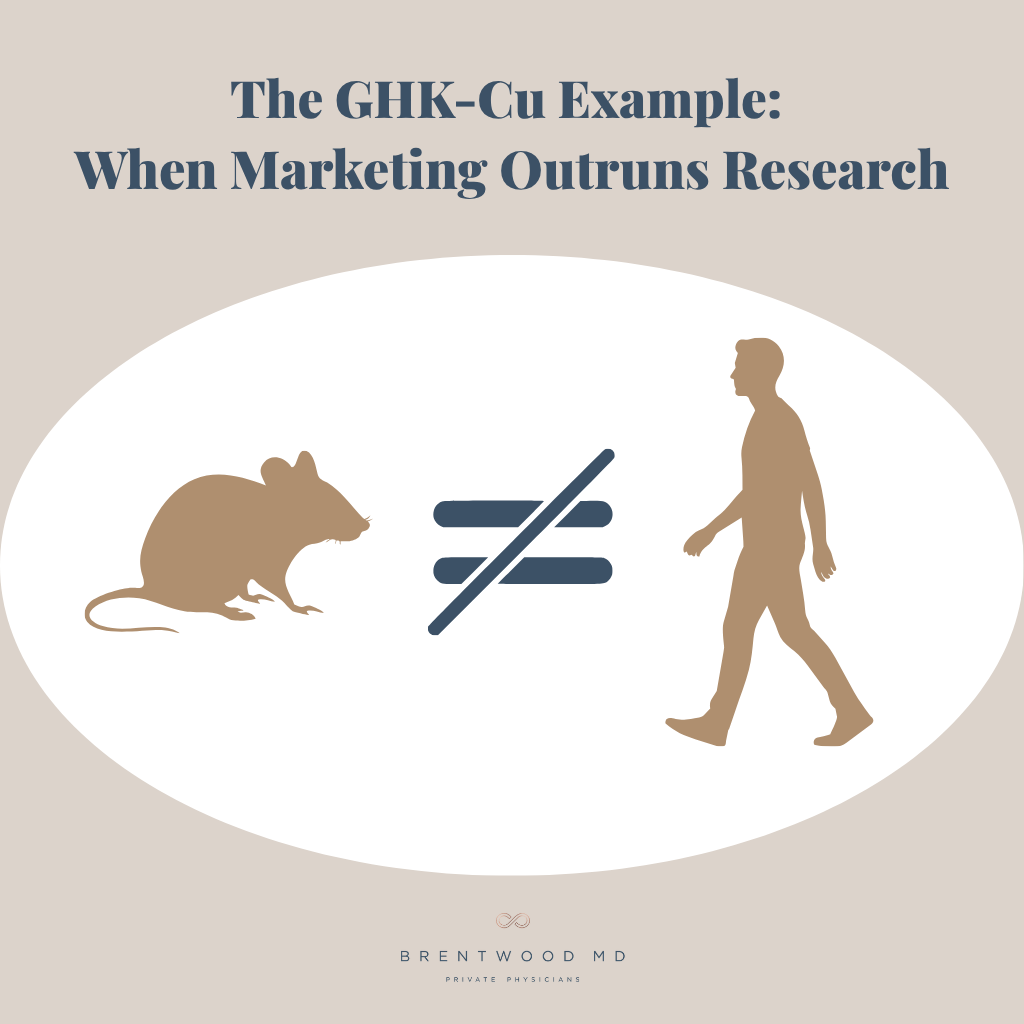
The GHK-Cu Example: When Marketing Outruns Research
Let me give you one specific case that illustrates the broader problem.
GHK-Cu, the copper peptide, is actually one of the better-studied cosmetic peptides. We do have some human data for topical use, including small trials on wound healing and modest improvements in skin texture. A topical preparation can, under certain conditions, be legally compounded.
Where things go sideways is when claims shift from “topical skin support with some evidence” to “injectable fountain of youth for skin, hair, and nails.” Those dramatic claims come entirely from cell culture and mouse models.
Why does this matter? Because cells in a petri dish can’t match the full complexity of the human organism. Neither can the bodies of mice or rats. They can give signals for eventual study in humans, but extrapolating laboratory results to human application is a much longer leap than many realize.
Unfortunately, when there’s money to be made, a modest signal in cells or animals can lead to marketing that races far ahead of what the research actually shows.
So could GHK-Cu provide significant anti-aging benefits? Possibly. The point is, we don’t know. And until we do, anyone using it runs the risk of unforeseen side effects and unregulated product production.
“Not FDA Approved” Isn’t a Single Category
One more argument I sometimes hear that’s worth addressing is this: “Peptides aren’t FDA approved, but neither are protein powder, creatine, or multivitamins, so what’s the difference?”
On the surface, it sounds reasonable. Under the hood, it’s a false equivalence. Supplements like creatine have decades of human data behind them, well-understood side effect profiles, and third-party testing programs. The evidence on creatine for both muscle performance and brain health is actually quite robust, as I covered in Why Creatine Deserves a Second Look: Benefits in the Gym and Beyond.
Research peptides from gray-market websites are something else. No standardized dose, no meaningful long-term human data, no oversight, and highly variable quality from batch to batch. Swallowing a well-characterized supplement and injecting an unregulated research-grade peptide are not the same risk category, even if neither carries an FDA approval stamp.
How I Approach Peptides in My Practice
My starting point for the issues peptides purport to address is always the foundations: nutrition, fitness, and recovery. These are the pillars of wellness, and no peptide replaces them.
For FDA-approved peptide therapies, like GLP-1/GIP agonists for diabetes and obesity, I’m comfortable prescribing within their established indications and monitoring patients closely. For everything else, I ask: Is there meaningful human data? What is the FDA’s position? Is there a legitimate supply chain? Does the potential benefit justify the unknowns around immunogenicity, hormonal disruption, and long-term risk?
If a peptide doesn’t clear that bar, I tell patients I can’t recommend it as a medical therapy right now, even if it’s trending online. My job is to be honest about the uncertainty and help people avoid the biggest landmines.
That said, I don’t want my members to be nervous or embarrassed to tell me if they decide to take a peptide anyway. As your doctor, my primary concern is your well-being, and if you’re taking a peptide, I want to make sure we’re mitigating risks and monitoring your health along the way.

If You’re Determined to Explore: A Harm-Reduction Framework
If my choice is either to let determined patients figure out peptides alone, or to engage honestly and non-judgmentally in harm reduction, I’ll always choose the latter. So, if you’ve decided to go ahead with peptide experimentation despite the potential issues, consider these steps for reducing risk:
Consider the source carefully. You can ask for a Certificate of Analysis, or CoA, from a pharmacy. It’s a batch-specific lab report tied to the exact lot of peptide you receive and should include the peptide’s name, amino acid sequence, lot number, test date, purity percentage measured by high-performance liquid chromatography (HPLC), and identity confirmation by mass spectrometry. For anything injected, sterility testing matters, too.
If a vendor can’t produce a batch-specific CoA with HPLC and mass spec from an independent lab, don’t put it in your body.
Watch for red flags. If products have “for research use only” printed next to dosing instructions, no physical address, no mention of independent testing, or suspiciously low prices, look elsewhere.
Start slow. Always begin with the lowest plausible dose, stop use at any concerning symptoms, and monitor your labs. I’ve had patients on multiple peptides develop unexpected lab value elevations, so we suspended use to investigate what was happening.
Find your team. Make sure you have a physician who has the time and willingness to hold candid conversations about issues like this.
What Are Peptides: Final Thoughts and Where I Land
So, what are peptides, in the end? A category that spans everything from game-changing, evidence-based medicine to poorly regulated substances being marketed ahead of their science.
Again, I’m actually quite optimistic about peptides in the future of medicine. GLP-1s have transformed how we treat diabetes, obesity, and metabolic disease, and they give me real optimism for what carefully studied peptide therapies might achieve. But we need more rigorous human data before I can recommend them to patients in good conscience.
My approach isn’t to dismiss the science or shame anyone who’s curious. My job is to be honest about what we know, help you avoid the biggest risks, and keep the focus on what we’re confident actually moves the needle: solid nutrition, consistent training, quality sleep, and evidence-based therapies with a real track record.
If you’re peptide-curious and want to talk through the current landscape, that’s exactly the kind of conversation we’re here to have at Brentwood MD.

Dr. William Pierce is a board-certified Family Medicine physician with experience in Emergency Medicine who joined Brentwood MD in 2025. He specializes in providing comprehensive, personalized care that combines preventive health strategies with acute medical expertise. Dr. Pierce is committed to building enduring patient relationships grounded in trust, clinical excellence, and collaborative health management.