Download file | Play in new window | |
The nutrition world has a noise problem.
A new study, a trending supplement, a viral claim about fasting or electrolytes or protein shakes, and suddenly everyone has a new non-negotiable rule to follow. Even if most of those rules don’t last.
Dr. Tiffany Watson, known to many as Dr. Tiff, has spent more than 25 years helping high-achieving individuals cut through that noise. She holds a PhD in health and human performance and is a certified strength and conditioning specialist, fitness nutrition specialist, and intuitive eating counselor. She serves as nutrition director at MPOWER Physical Therapy in Nashville, Tennessee, and works with clients both in person and virtually across the country.
Dr. Tiff recently returned to our Future of Medicine podcast for a second conversation. In our first episode together, we covered her Fuel, Sweat, and Science framework, the importance of macronutrients, and how hormonal shifts in midlife affect body composition. This time, we went deeper into the lifestyle factors that shape nutrition outcomes and tackled some of the most common myths in the performance nutrition space.
Overlooked Foundations: Sleep, Stress, and Gut Health
Nutrition doesn’t exist in isolation. What you eat matters, but so does how well you sleep, how you manage stress, and how effectively your gut is processing what you give it. These factors don’t just run alongside your nutrition plan. They shape what it can actually do for you.
“Sleep and stress both can drastically impact how our body absorbs nutrients, how it recovers, how it faces the next day,” Dr. Tiff says. When sleep is poor, the body compensates. You reach for caffeine and sugar to chase the energy you didn’t get.
The motivation to exercise also drops, since your body wants to preserve what energy it has. Shame and guilt follow, which compounds stress, which further disrupts sleep. It’s a cycle that can quietly undermine a nutrition plan that looks good on paper.
The fix isn’t complicated. Making small changes to improve your bedtime routine, such as getting off screens with enough time to wind down, being mindful of late-day caffeine, and watching evening alcohol intake. Even a 10-minute walk after dinner can help with digestion and begin bringing the body down from the day’s demands.
DOWNLOAD OUR FREE EBOOK
Concierge Medicine is the future of healthcare.
Five honest questions to help you decide, plus a clear look at how membership medicine differs from the care you have now.
THE CONCIERGE MEDICINE GUIDE
Is Concierge Medicine Actually Right for You?
On the topic of gut health, Dr. Tiff notes that attention has increased significantly in recent years as more information has come to light. The gut is where nutrition is absorbed. If your gut isn’t functioning well, the food you’re eating can’t deliver its full benefit.
Dr. Tiff’s main focus for gut health isn’t a long list of supplements. It’s high-quality ingredients and a balanced diet.
She raises one additional point worth paying attention to: As human beings, we tend toward overcorrection. We’ve seen this with protein over the last few years, to the point where many people are probably getting too much, and we’re seeing it now with fiber.
Previously, the problem was not enough fiber. Now, people are overdoing it with supplements and low-carb products that pack in manufactured fiber to reduce the net carb count on the label. “That’s the bloating, that’s the irritation in the gut that we’re seeing,” she says. Whole food dietary fiber, not manufactured fiber added to drive down a number, is the goal.
Hormones, HRT, and What Diet Can Actually Do
Since we have members of our practice who are on hormone replacement therapy, I asked Dr. Tiff whether that alters the optimal nutrition strategy for them. Her short answer is no, we’ll simply see better results from normal, healthy nutrition. “If all their hormones are now optimized,” she says, “then we’re probably going to see better success from implementing the nutrition strategies and the training.”
A more nuanced conversation is for those who aren’t on hormones but want to support their body’s natural hormone production through diet. Dr. Tiff’s answer here isn’t a specific protocol, but a principle: quality over quantity.
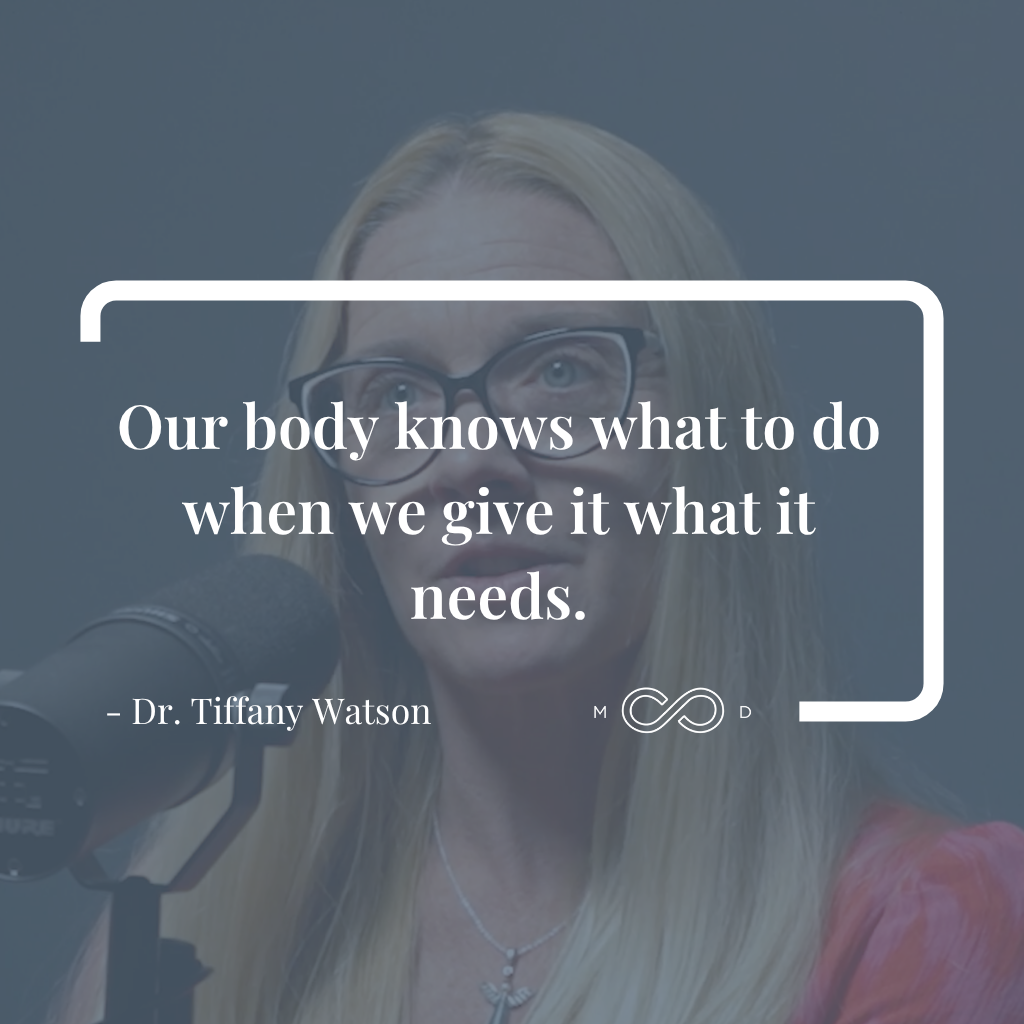
Rather than fixating on hitting numbers with whatever foods are convenient, she focuses on sourcing nutrition from foods that actually support how the body produces, absorbs, and uses hormones. “Our body knows what to do when we give it what it needs,” she says, “so just trying to give it the right things at the right times in the right amounts is going to support our body’s natural rhythms.”
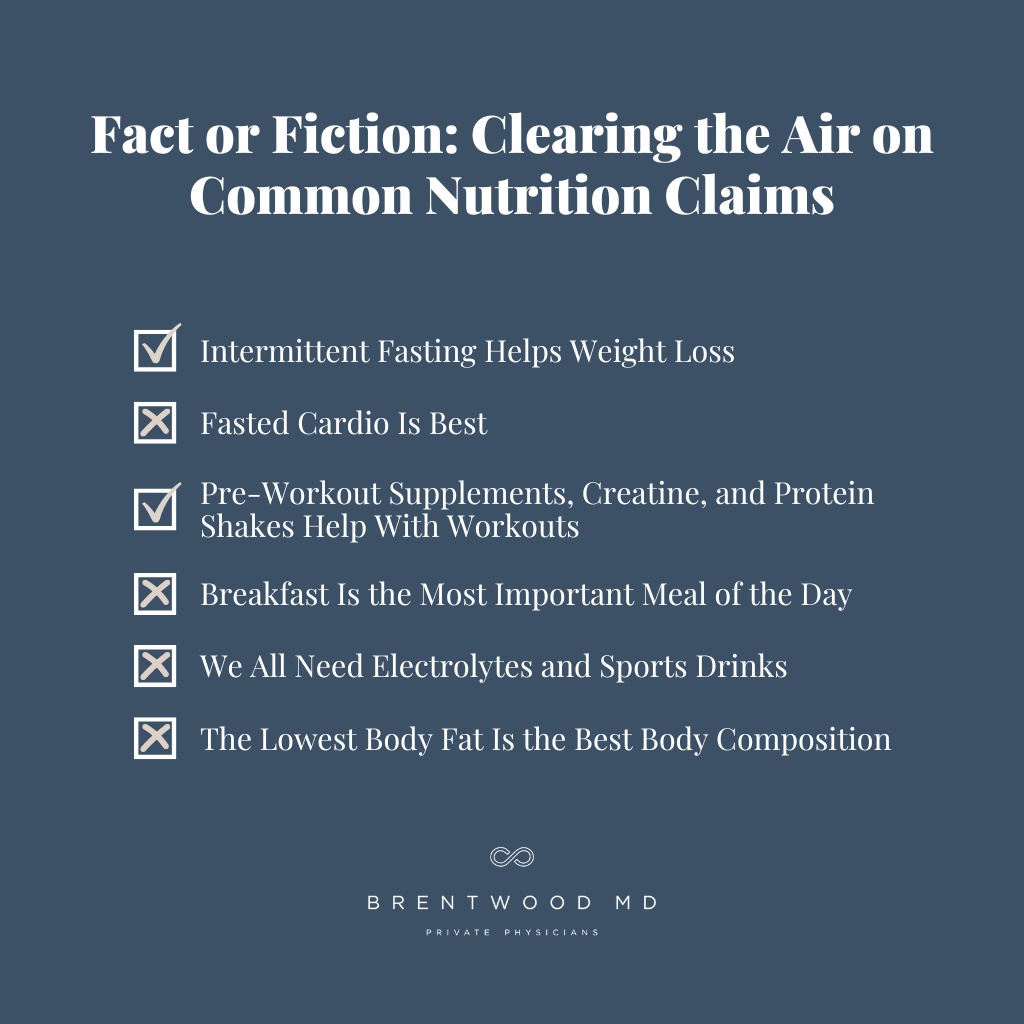
Fact or Fiction: Clearing the Air on Common Nutrition Claims
This is where the conversation got into territory a lot of people have questions about. We went through several popular questions and beliefs one by one.
Claim: Intermittent Fasting Helps Weight Loss
Intermittent fasting is time-restricted eating, which is one of several ways to create a calorie deficit. “If your goal is to lose body fat or weight, people misunderstand that it’s the fasting itself that causes the progress,” Dr. Tiff explains. “It’s the fact that you’re eating fewer hours of the day, thus you’re probably consuming fewer calories.” She emphasizes that someone who overeats within their feeding window won’t lose weight.
That said, Dr. Tiff has heard people share that fasting improves their mental clarity. If that’s the case, and you can maintain a healthy diet and workout routine, she supports the practice. But she shares an important caveat for anyone focused on building or maintaining muscle: Don’t train fasted without accounting for recovery.
If you work out at 7 a.m. without eating since dinner, and then you don’t eat again until noon, your body has nothing to work with for repair. “We don’t want to create breakdown with nothing to offset it,” Dr. Tiff says, “especially when we’re already struggling in those 40- to 60-year-old age brackets to build and maintain muscle.”
Claim: Fasted Cardio Is Best
The research is clear on this one. When controlling for calories and training volume, fasted and fed cardio produce the same results. There is no fat-burning advantage to training on an empty stomach.
Burning fat as a fuel source during a workout isn’t the same as losing body fat. Body fat loss comes from a sustained calorie deficit over time. So if you’re trying to lose fat, Dr. Tiff suggests doing whichever feels better. If you train fasted in the morning, make sure you eat within an hour after to offset breakdown. If you train in the afternoon after a couple of meals, that post-workout meal is less critical.
Claim: Pre-Workout Supplements, Creatine, and Protein Shakes Help With Workouts
Creatine is one of the more well-supported supplements available. Research consistently shows benefits for muscle maintenance and recovery, and there’s emerging evidence for cognitive benefits at around 10 grams per day.
However, creatine isn’t a “pre-workout” energy boost. It builds up in the system over time. If you’re training five days a week, you should take creatine seven days a week. It’s a long-term investment, not a daily stimulant.
For pre-workout supplements generally, Dr. Tiff recommends caution. Many commercial options contain very high levels of caffeine and added sugar or other poor-quality ingredients. A single cup of coffee alongside a whole-food alternative, like a banana, some applesauce, or a small snack, will often do the same job without the additives.
When it comes to protein shakes, choosing wisely matters. Pre-made, shelf-stable shakes tend to be low-quality and highly processed. A thoughtfully chosen, high-quality protein powder, like those from Thorne or Transparent Labs, mixed at home with fruit, vegetables, and a milk or milk alternative, is a different product altogether.
However, Dr. Tiff considers protein powder a supplement, not a staple. It shouldn’t replace actual whole food protein in your diet.
Claim: Breakfast Is the Most Important Meal of the Day
Dr. Tiff says myth, but with nuance.
If you train in the morning, breakfast becomes your recovery meal and matters significantly. But if you’re training in the afternoon, there’s nothing special about eating at 8 a.m.
For many people, the real issue is practical: If you skip breakfast, you only have two meals to get enough nutrition into your body. Hitting 60 grams of protein in each of two meals is much harder than spreading it across three or four.
The priority isn’t the timing. It’s making sure your body gets what it needs across the whole day.
Claim: We All Need Electrolytes and Sports Drinks
Dr. Tiff says this one is largely marketing. If you’re doing a 30-minute Zone 2 workout, a sports drink simply isn’t necessary.
Electrolytes have a genuine place for people sweating heavily, dealing with illness, or following a very low-carb diet that strips hydration. For most people eating a regular diet, which already contains significant sodium, many electrolyte packets add more than the body needs and can actually disrupt fluid balance. She suggests using them when there’s a real reason, not as a daily habit.
Claim: The Lowest Body Fat Is the Best Body Composition
Dr. Tiff says false. Each body has an optimal zone, and pushing below yours comes at a cost. “As you lose weight, as you get leaner, there is a point of diminishing return where systems will start shutting down because the body will prioritize primary function,” she explains.
Digestion, muscle mass, bone density, hormonal function: none are the body’s top priorities when it’s under-resourced. Symptoms like brain fog, disrupted sleep, loss of menstrual cycle, and nagging injuries can all be signals that the body isn’t being adequately nourished, not that a training plan needs to be more aggressive.
Technology: Useful Tools, Real Limits
Dr. Tiff uses MyFitnessPal with her clients as a starting point for food tracking and has found it consistently practical. The free version has an extensive database, supports recipe imports, and does what most people need. She considers it a good way to establish a baseline.
For wearables like the Whoop, Oura Ring, and Fitbit, Dr. Tiff offers a measured view. These devices provide useful trends and general direction, but none are fully accurate. Home body composition scales, for example, carry a 3 to 5% error rate and are highly sensitive to hydration. A two-pound muscle gain from one day to the next on your bathroom scale didn’t happen. She recommends looking at the long-term trend, not the daily number.
The more important point Dr. Tiff makes here is about information overload. “I don’t want them to overwhelm people,” she says. “The real point is just to make healthy changes.”
Continuous glucose monitors are one example. Seeing a spike after eating a banana can send someone down a path of food avoidance that misses the larger picture. What matters is how quickly blood sugar recovers, not whether any spike occurs at all.
As I’ve seen with many of our Brentwood MD members, more data isn’t always more useful. It can be genuinely valuable, but only when it’s being interpreted correctly and applied to the actual goal.
The Goal: Graduating to Intuition
Though Dr. Tiff uses tracking, measuring, and counting during the initial phases of nutrition coaching, they aren’t the destination. They’re the crash course that makes the destination possible.
Dr. Tiff talks about this as graduating to intuitive eating. Nobody wants to weigh and log every meal for the rest of their lives. But without doing that work for a period of time, it’s hard to build the visual and contextual awareness that makes intuitive eating possible.
Once you’ve tracked consistently, you start to recognize what a portion actually looks like. You can walk into a restaurant and sense that the serving of rice in front of you is twice what you’d use at home. You can travel, attend events, and enjoy your mom’s lasagna without losing track of where you are.
“Once you start to build those visual cues,” Dr. Tiff says, “when you’re traveling, when you’re on vacation, when you’re at a friend’s house for dinner, you can be much more intuitive about, this is an appropriate portion for me.”
The goal isn’t perfect adherence. It’s conscious awareness. When you choose to eat more than you need, you’re making that choice deliberately, not stumbling into it.
Nutrition Coaching With Dr. Tiff
Dr. Tiff has worked directly with members of our practice, and we’ve been impressed with the results. Nutrition, when approached with this level of specificity and sustainability, is a real momentum multiplier for health.
If Dr. Tiff’s approach resonates with you and you’d like to take the first step toward coaching, you can reach out to schedule a free strategy call with her at workwithDrTiff.com. She’s also active on Instagram at @workwithDrTiff, where she shares content on her philosophies and approach to performance nutrition. She works with clients both locally in Nashville and remotely across the country.
At Brentwood MD, we view nutrition as one of the core pillars of a member’s overall health. When that foundation is solid, everything else we do together works better.

Dr. Wright joined Brentwood MD in 2022 as the model allows him to spend more time connecting with patients and build a foundation of exceptional care. He is a Nashville native and completed his family medicine residency at the University of Tennessee Health Science Center, where he also served as Chief Resident. He believes that your health deserves a prominent position on your priority list, and would be honored to serve you and your family.
Dive deeper into maximizing your lifespan and healthspan with Dr. Aaron Wenzel’s new book.